


- Home
- Companies
- VacuTec Meßtechnik GmbH
- Products
- VacuTec - Industrial Ionization ...
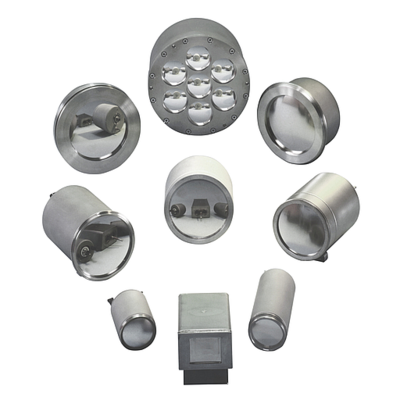
VacuTec - Industrial Ionization Chambers for Radiometric Measurement
VacuTec Meßtechnik GmbH has specialized in the development and production of industrial ionization chambers for over five decades. These chambers serve as sensors in traversing measuring systems designed for radiometric measurement of thickness, area mass, and density in various industrial applications. Utilizing the transmission and backscatter principle, these sensors offer a rugged construction, extensive linear working range, and a compact design. They are engineered for long service life and stability under thermal variations, making them ideal for high-speed processes with a reaction time of a few milliseconds. Standard manufacturing involves precision welding of nickel-chromium steel for beam entry ports. Alternatively, vacuum-tight connections with other materials such as titanium or beryllium are achieved through advanced bonding techniques. Additionally, chambers can be filled with high purity gases like krypton, xenon, or argon, enabling their use in specialized applications where specific pressure levels are required.VacuTec Meßtechnik GmbH has been producing high quality ionization chambers for industrial applications for more than 50 years. Ionization chambers of this type are mainly used in traversing measuring systems as sensors for radiometric thickness, area mass and density measurement applications. These measurements are based on the transmission or backscatter principle. Ionization chambers for industrial applications offer the advantages of rugged construction and a wide linear working range. They are characterized by their compact design, high stability and long service life. Our chambers have a very high thermal stability and are ideally suited for high-speed processes due to their time constant of only a few milliseconds. If using nickelchromium steel foils, as is standard practise, the beam entry windows are precision-welded with the high-grade steel housings, thus ensuring an excellent tightness of the chambers. The vacuum-tight connection of alternative foils of titanium, beryllium, aluminium or plastics is achieved by latest bonding techniques. High purity gas fillings using krypton, xenon or argon are used for specific applications at the corresponding pressure level.
The measuring setup consists of a radioactive source, an ionization chamber as detector and a signal conversion. The radioactive radiation excites an ionisation current in the ionisation chamber. Material between source and detector absorbs a part of the radiation and therefore reduces the ionisation current. The reduction of the current depends on the basis weight or thickness of the material.