


- Home
- Companies
- Probst & Class GmbH & Co. KG
- Products
- PUC - Model EVA - Vacuum De-Aeration ...
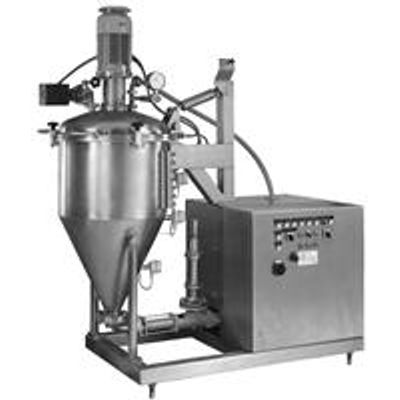
PUC - Model EVA -Vacuum De-Aeration Unit
PUC EVA vacuum de-aeration units are used in many different sectors including the pharmaceutical, chemical/petrochemical, cosmetics and foodstuffs industries. EVA vacuum de-aeration units are used for the continuous de-aeration of liquid to pasty products. These units can process all the greases from NLGI 0-6 which are normally used, foodstuffs (e.g. mayonnaise, ketchup, mustard, sauces, jams, pastes, etc), chemicals, lotions and suspensions. For the continuous de-aeration of liquid to pasty products, up to 10,000 kg/h.
Mode of operation
The product to be de-aerated is fed to the vacuum vessel via a distribution system adapted to the characteristics of the product. The product then flows down the inner walls of the vessel as a thin film or in droplet form and collects in the conical bottom section of the vessel for removal. This process is based on the increase in the surface area of the product, which shortens diffusion paths. As a result, gases such as oxygen, which may be finely distributed within the product or adhere to solid particles, are released and can be effectively removed. The temperature of the product remains unchanged during this process.
The size of the vacuum vessel depends on the capacity required and the de-aeration behaviour (viscosity and surface tension) of the product. The distribution system is adapted to these characteristics.
PUC EVA vacuum de-aeration units are available for fully automated continuous operation.
Production and quality at PUC
PUC vacuum de-aeration units are available in standard sizes with capacities of up to 10,000 kg per hour and more depending on the material processed. PUC vacuum de-aeration units are easy to install, operate, maintain and clean. PROBST & CLASS has decades of experience in the design and production of vacuum de-aeration units throughout the world. The products meet customers’ most stringent technical and quality requirements.
- Increased chemical stability
- Avoidance of oxidation
- improved metering precision during filling
- Precise packaging volume/weight
- Faster emulsifying
- Improvement in product appearance with smooth, even surface