


- Home
- Companies
- Piping Technology & Products Inc
- Products
- Variable Spring Supports
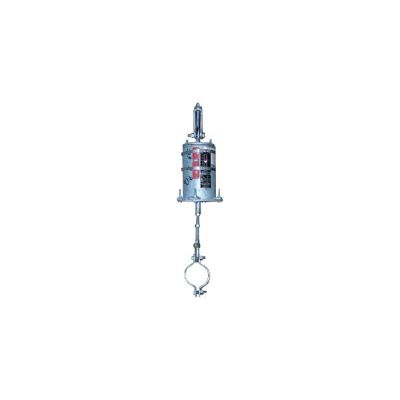
Variable Spring Supports
Variables use coiled springs to support a load and allow movement. The resistance of the coil to a load changes during compression, which is why these devices are called `variables`. There are many different designs for variable supports and a particular nomenclature used to identify them. The term `type` is used with an alphabetical designation (A-G) to describe seven different physical connections to the supporting structure. The figure below illustrates the applications and the physical connections for each type. Hangers are suspended from structural members while base supports (Type F) rest on a supporting surface.
Piping systems are used to transport gases, liquids and suspended solids between units of a plant. The temperatures of the contents and the pipe when the plant is in operation are often quite different from the ambient temperature of the surroundings. The heat transferred during changes in temperature causes metal pipe to expand and contract. Piping designers must provide for movement due to temperature changes and forces caused by pumps, gravity and other elements of the piping system.
Proven engineering practices are included in various codes for piping services developed by professional societies such as the American Society of Mechanical Engineers. Most companies use these codes to develop specific standards for their products. The Manufacturers` Standardization Society has developed standards for pipe supports. Designs which satisfy codes are important to satisfy laws and to obtain financing and insurance for projects. Table 1 provides a list of some important standards.
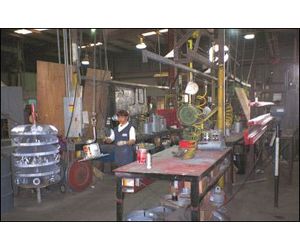
Variable springs are one of the most important devices available to help support pipe. They are used to balance the concentrated gravitational load of vertical sections of pipe while allowing for thermal movement. Control of the direction and amount of movement of various sections of pipe is a major function of piping design. Computer models are used during design to predict the forces and movement at the point where a spring support is attached to the pipe. This is the information required to select the least expensive variable spring to use.
Variable springs are relatively inexpensive and very reliable. When replacement is necessary, the engineer needs to determine if the original size is still appropriate or if the system has changed and different forces and movement must be considered.
Difference - The major differences between standard springs and furnace springs are in their construction and their intended use. Furnace springs operate in much the same way as other variable spring supports. They are designed to support the pipe or tubes that are subjected to vertical thermal movement. The design changes are necessary because furnace springs are exposed to extreme temperatures.
Coatings - Furnace springs are almost always coated with red oxide primer in order to avoid any potential hazards when exposed to high temperatures. Standard springs are usually hot dipped galvanized, which, when exposed to high temperatures, tends to melt the zinc coating. The molten zinc can then cause damage to the surrounding pipe and equipment.
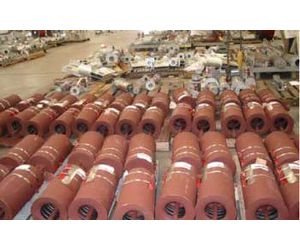
Construction - Whereas many of the standard variable spring components are interchangeable, the furnace spring assemblies are constructed from components unique to its application and intended use. The furnace spring incorporates a welded design for the housing assembly unlike standard spring housings that use a bolted configuration. The internal components of the furnace spring are designed to center the spring coils within the spring’s housing to prevent misalignment. In addition, the spring housing is modified to accommodate lug attachments on existing furnace tubing and equipment. Special fabricated casings, spring coils, and nameplates may also be used to accommodate increased travel.
Design - Some furnace springs are designed in order for the spring to be used as a means to determine the loading of the catalyst tubes. In these applications, an exact spring rate is determined for each assembly. The exact spring rate (which may differ slightly from published spring rate values) can then be used to determine the weight of the tubing system in order to balance the unit.
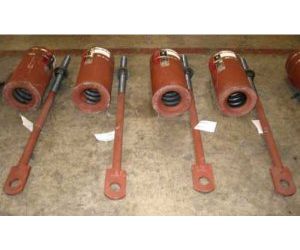
What is the difference between a variable & a constant spring support? In a variable support, the force acting on the spring and hence the reactive force varies during the pipe travel, while the moment about the line of action is zero. In contrast, in a constant support, the fixed applied load remains uniform throughout its travel but the moment around a pivot point varies.
What is a variable support? A variable support is essentially a spring, or series of springs, in a container. When the installed load “w” is applied, the spring is compressed through the distance W/k (where k is the spring rate) such that the reactive force exerted by the spring is also “w” under the equilibrium condition. As the pipe moves due to thermal expansion, it produces a deflection (∆L), causing a differential load (∆W=k ● ∆L), to act on the spring(s). Depending upon the direction of the movement, the change in load (∆W) will either add to or subtract from our installed load “w” to reach our final operating load (w1). In order to minimize the stress variations, the differential load (∆W) for a given variable spring support is limited to a maximum of 25% percent of the operating load (w1).
What is a constant support? A constant support is a device comprised of a spring or series of springs and an integral cam mechanism. The external load of a constant support is fixed while its moment about the fixed pivot point varies during its travel (because the moment arm length changes). In order to maintain an equilibrium condition, the external force moment is balanced by the internal moment produced due to the spring’s compression or decompression about the pivot during the displacement of the pipe.
With an appropriate choice of moment arms, as developed by the cam geometry, and spring properties (i.e. spring rate), a resisting force can be provided that is nearly independent of position during its travel.
At each travel location of the applied load, the moment caused by the external load is balanced by the counter moment produced by the (compressed/decompressed) spring force with the appropriate moment arm. Typically, the variation of the active and reactive forces is very small (with a maximum deviation of 6%) and can be taken as a constant force while moving either upward or downward.