


- Home
- Companies
- SMG Industries Ltd
- Products
- SMG - Vibrating Rundown Screens
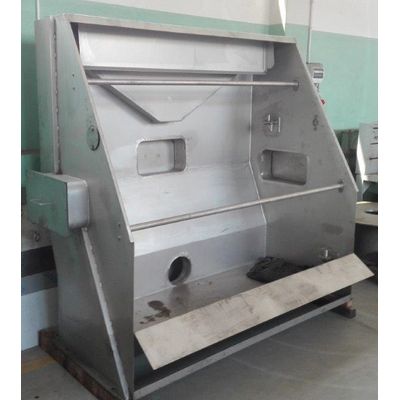
SMG - Vibrating Rundown Screens
Vibrating rundown screens are a step up from our simplest Static Rundown units that are a non-compaction, separation, or dewatering unit that has very few moving parts, making them a very cost-effective solution that requires very little maintenance. Rather than being fitted into the unit’s main frame as per our static rundown, the curved sieve screen is fitted into a cradle that is mounted on 4 springs within the unit’s main Frame. The screen cradle has two rotary vibrators attached that gently vibrate the sieve screen at high-speed: independently of the main frame. These electrical vibrators consume very little power as they are fractional kW motors with single & 3 phase options.
The function is identical to our static rundowns where the input slurry that needs separating is pumped or gravity fed into the top-mounted header tank above the Sieve Screen, when full, the slurry flows over the built-in weir and runs down onto the Sieve Screen starting the separation process – see Rundown Screens for more details.
The high-speed vibration of the sieve screen significantly increases the efficiency of the rundown concept over a static unit, as the added vibration and agitation dynamic:
- Speeds up the separation process giving a higher throughput, as the solid matter on the screens surface gets conveyed down and off the end chute quicker
- Forces more liquid to pass through the Screen giving a higher dry matter solid element
- Enables a smaller gap size Wedge Wire screen to be used, leaving less solid matter in the separated liquid
- Able to process input slurries that have a higher dry matter content and are more difficult to use.
Can be used in many applications & industries, and tailored for many installations:
- Standalone units are not only sited in one fixed position on the ground or a gantry/framework but can also be mobile to be taken to numerous locations: mounted on a trailer, have wheels/casters, or made for craning or forklifting. When supplied for mobile applications, the supplied transit locks need to be deployed each time the unit is moved to stop the screen cradle from becoming detached.
- Integrated into a process line where the incoming slurry or outgoing solid/liquid elements are processed.
- Scalable, where many rundown screen units can be coupled together to meet large-scale capacity requirements, enabling huge throughputs.
- Built into a flow/waste-water channel or waterway where solids or unwanted contaminants need to be removed or captured. Single or coupled units can be used to bridge the width of the channel or meet the throughput/capacity requirement. Working on the same function principle – the flow stream breaches the unit’s weir and can be used in two ways:
- To clean up a waterway/drainage channel or capture solids – the solids left on the upper surface of the screen are taken down the solids route, and the liquid that has passed through the screen continues down the channel.
- Flow reduction/control and capturing of the liquid element – the liquid that has passed through the screen is captured and is routed away, any solid matter and surplus flow that has overwhelmed the sieve screens capacity, continues down the channel.
All the above designs have options for covers, doors, and manual or automatic washing. See Filtration for products to enable the washing water to be recycled.
As some of the above configurations are built into installations, all our units are designed so that the sieve screen cradle can be easily lifted out without having to remove the whole unit.
Although our vibrating rundown screens make the best use of the curved, tilted wedge wire sieve screen technology, along with vibration, agitation, and gravity, there are still certain limitations:
- Slurries with a low dry matter, simplistically pumpable
- The minimum size of solid particle removal is around 80 microns as generally, any smaller would cause blinding/screen blocking issues, even with automated washing. This can be overcome by considering a Rotary Screen separator or a compaction machine, or another option is using coagulation technology, visit coagulation on this site for more details.
- Some greasy, sticky, certain viscous, and dissolved solids slurries tend not to work on rundowns as they will cause blinding issues, we can advise on this, and/or consider other separator types.
- The dry element tends to be a low dry matter and is non-stackable – needs contained storage.
The slurry throughput of a rundown screen is determined by a combination of three parameters:
- Slurry type & its viscosity:
- We can generally advise
- Rundown size, screen width & height:
- Standard units:
- Width options 0.5m – 1.7m
- Height options, 1.25m & 1.9m
- Bespoke sizes and designs can be made
- Coupling units together to fit into a specific installation or to cater for a large throughput
- Solid particle size removal from the liquid:
- From 0.08mm – 2.0mm (larger gap sizes can be supplied).