

- Home
- Companies
- Vortex Hydra S.r.l.
- Products
- Vortex - Model Modulo 120 - Velocity ...
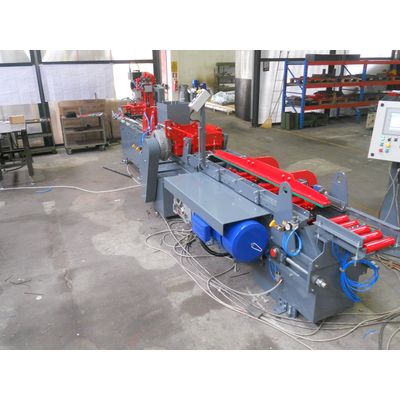
Vortex - Model Modulo 120 -Velocity Plant
The roof tile manufacturing process is basically the same as that of the VORTEX MODULO 60 plant with exception that all the plant and equipment has been designed and quantified to operate at a speed of up to 120 tiles per minute.
Again, the roof tiles are formed on precision cast aluminum pallets that are chain driven through an extrusion machine. After the newly formed wet tiles and supporting aluminum pallet exit the extrusion head on the machine the tiles are cut to their correct length by a ‘double-flying’ cutter unit that is operated by a servo motor. The unit has a crank connection that is directly synchronised to the pallet drive mechanism to ensure precision cutting of the tiles.
Both the chain drive in the machine and the tooling in the extrusion head are driven by two separate electric self-braking motors. These motor units are controlled by invertors to enable fine tuning of both the pallet advancement through the extrusion machine and the rotation of the forming roller in the extrusion head.
Heavy duty conveyor systems are employed within the plant for the travelling and handling of tiles and aluminum pallets.
An automatic racker/deracker machine is employed for loading the wet tiles in and out of the steel curing racks. The loaded racks are transported to and from the curing chambers by a forklift truck or the like. They are stacked two high in the chamber to reduce the curing area needed. Each rack has a a 390-tiles capacity. A curing chamber requires a temperature of a least 30°C to enable the wet tiles to cure over a 24-hour period or 55/60°C temperature with humidity of 95% when only an 8-hour curing period is required. Depending on local conditions it might be necessary to install a heating system when these temperatures cannot be achieved naturally.
When curing is completed the dry tile and supporting aluminum pallet are conveyed through an automatic depalleter machine for separation.
Like the MODULO 60 operation the empty aluminum pallets are conveyed back to the tile extrusion machine, via a turntable and oiler unit for re-use while the separated dry tiles are travelled to the automatic packer machine. If required, the top surface of the tile can be painted en-route to the packer. When surface painting is required a long transport conveyor is added to the system that enables the acrylic paint to dry before the tile enters the packing machinery.
MAXIMUM OUTPUT
120 tiles/minute
MINIMUM BUILDING SIZE
26 m x 90 m x 8 m high
INSTALLED POWER
~ 150 kW (mixer included)
PRODUCTION
49.000 tiles per shift