- Home
- Companies
- AWS Corporation Srl
- Products
- AWS - Wet ElectroStatic Precipitator ...
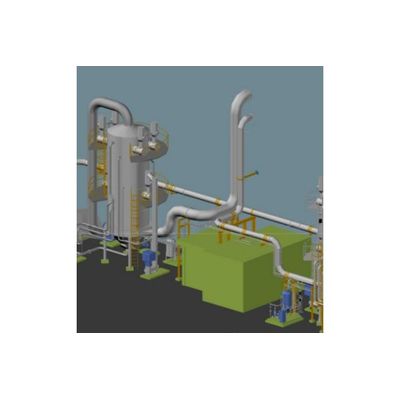
AWS - Wet ElectroStatic Precipitator (WESP)
Wet Electrostatic Precipitator* (WESP) offer efficient emission* control (or nib micron particulate, heavy metals, acid mitt, oil mist. The WESP it recommended because of its proven performance, compactness, robust decien. automatic operation, and low operating costs.
Field of application:
- Textile processing
- Veneer and particle board dryers
- Phosphorous furnace emission
- Silicon manufacturing
- Hazardous waste incinerator
- Plastics and gasket manufacturing
- Biomass drying
- Sulphuric acid plantsFood drying
Pollutants removed:
- HCl, HBr, HF, H2S, NH3
- SO2, SO3, SiO2
- Oil mist, sub-micron particulate, VOCs
- Aldehyds, phenol
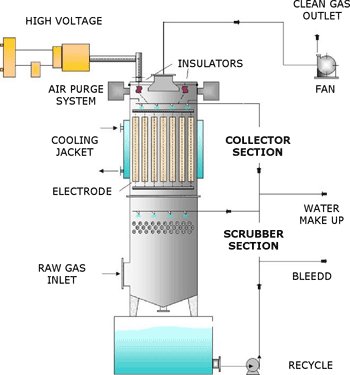
Scrubber section
Hot contaminated gas from the production lines are cooled to full saturation and pre-cleaned from all particles larger than 2 microns in a special un-clogging scrubber. The scrubber creates a turbulent layer of fine mist which accomplishes the mass transfer of toxic gases and the capture of large particles onto the mist bubbles. The turbulent layer provides good mass transfer and offers efficient gas cooling below adiabatic saturation together with good absorption of soluble compounds.
In the vertical design, the evenly distributed saturated gas flows upward through the electrostatic section of the WESP.
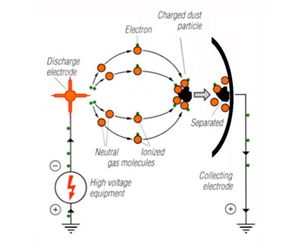
An ionizing electrode runs down the centre of each tube. A strong electrical field is generated between the central discharge electrode and the collecting tube.
Electrons are emitted from the discharge electrodes which are charged with a rectified negative high voltage. Due to the high voltage difference, these electrons migrate towards the collecting electrodes: as particles pass through the gap between the discharge electrodes and the tube walls, they are intercepted by negatively charged gas molecules. These negatively charged gas molecules or negative ions accumulate on the particles surface and become fully saturated with negative charge.
As the gas with charged particles passes up the tube, it enters the collection section where there are strong repelling forces. The strong electrical field causes the charged particles and entrained droplets to migrate to the inner surfaces of the tube and consequently to be removed from the gas flow.