


- Home
- Companies
- Dust Solutions, Inc.
- Products
- DSI DustTamer™ - Wind Fence Dust ...
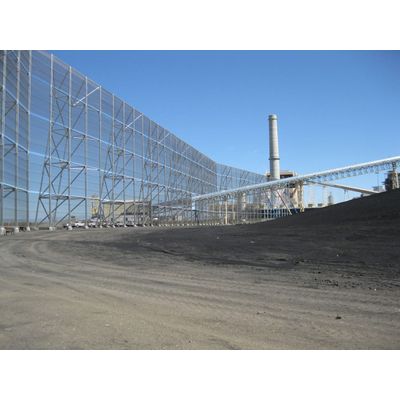
DSI DustTamer™ - Wind Fence Dust Suppression System
DustTamer™ wind fence systems are designed to combat wind erosion and dust emissions typically generated from open stockpiles and various industrial activities. Recognizing that something as subtle as wind speed reductions can mitigate up to 75% of dust emissions, the DustTamer™ system utilizes a porous material that reduces wind velocity and balances differential pressure across the barrier. This slows down the wind speed in the sheltered area, preventing particle uptake and therefore reducing airborne dust. This system operates by creating displacement flow, wherein a portion of the air is allowed to pass through the screen to mitigate pressure differentials, ultimately neutralizing the impact of high-velocity wind on stored materials. Engineered through computational fluid dynamics (CFD) modeling, DustTamer™ integrates advanced analysis to identify optimal fence height, material porosity, and placement needed for effective dust suppression. The system, which encompasses everything from design to structural engineering and installation, contrasts other materials such as basket weave fabrics and metal wind fences that are prone to clogging and structural degradation. The unique flexible and self-cleaning design of DustTamer™ ensures long-term efficiency and maintenance, making it a robust and reliable solution for controlling wind-induced dust in heavy industrial applications.
The concept behind how a wind fence works is easy to understand. If a solid wall is used as a wind break, two different pressure zones are created as wind movement towards the wall increases. Because impermeable materials, such as a solid wall only deflect wind, not reduce it, any openings for equipment access or areas on either side of the wall can funnel high pressure ambient air into the low pressure interior. This results in increased air velocities within the protected area. This will also cause wind to flow over the wall and create a turbulent movement on the other side, amplifying the wind speed and creating more particle uptake.
Conversely, if a porous material is used, high velocity wind that moves toward the stockpile will be diminished as the porosity will allow for air to pass through and equalize differential pressure on either side of the barrier.
Wind Velocity Reduction
The primary purpose of a wind fence is to reduce wind velocity moving towards the storage pile and prevent particle uptake in the protection zone. Particle movement can take place in three different ways: rolling, saltation, or suspension.
- Rolling / Creep: Rolling and sliding movement of larger particles along the ground. Depending on wind velocity, material can be moved to another pile.
- Saltation: Movement of particles by a series of short bounces along the ground which also dislodges additional particles with each impact.
- Suspension: Fine particles move parallel to the surface and upward into the atmosphere by strong winds. Particles can be carried high into the atmosphere, only returning to earth when wind subsides or they are carried down with precipitation. Suspended particles can potentially travel hundreds of miles.
DustTamer™ wind fence material is designed to exert a drag force on oncoming wind and reduce wind speeds up to 75% within the sheltered area.
By controlling wind speeds, it is possible to control levels of particulate matter in the air. The material allows a portion of the wind volume to penetrate through the screen as well as deflect the remainder of the wind to the surrounding sheltered area. Subsequently, the velocity lowers to the point required to initiate particle movement and prevent suspension. Air passing through the screen is referred to as “displacement flow”. The displacement flow and wind velocity are determined by the permeability of the screen.