


- Home
- Companies
- WindCom Messtechnik e.K.
- Products
- WindCom - Wind Transmitter
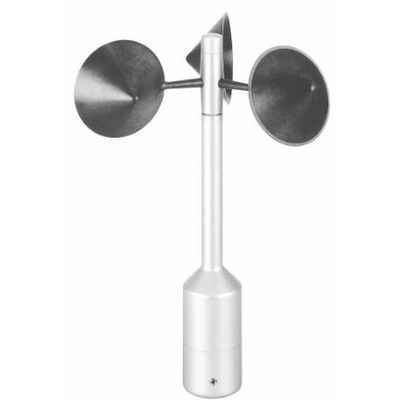
WindCom - Wind Transmitter
The wind transmitter is designed for the measurement of the horizontal component of the wind speed in the field of meteorology and environmental measuring technology, evaluation of on-site wind potential, and measurement of capacity characteristics of wind power systems. The device features optimized characteristics, dynamic behaviour at high turbulence intensities, minimal over-speeding, and low starting values. The measuring value is available as a digital output signal at the output. It can be transmitted to data loggers as well. For winter operation the instrument is equipped with an electronically regulated heating, which guarantees a smooth running of the ball bearings, and prevents the shaft and slot from icing.
Construction and Mode of Operation
A low-inertia cup star with 3 cups, made of carbon-fibre-reinforced plastic, is set into rotation by the wind. The rotation is scanned opto - electronically, and is converted into a square wave signal. The frequency of this signal is proportional to the number or rotations. Depending on the supply voltage, the output signal ranges between maximal output voltage and ground or a potential (life-zero), lifted by approx. 1,2 V. The supply of the electronics can be done by DC-voltage of 3, 3 V up to 42 V at a very low current consumption. An AC- or DC-voltage of 24 V is intended for the separate supply of the optional heating. In all probability, the heating guarantees a trouble-free function of the Wind Transmitter First Class even under extreme meteorological icing-conditions.
The outer parts of the instrument are made of corrosion-resistant anodised aluminium. Highly effective labyrinth gaskets and O-rings protect the sensitive parts inside the instrument against humidity and dust. The instrument is mounted onto a mast tube; the electrical plug-connection is located in the transmitter shaft.