


- Home
- Companies
- Fluid Control Europe (F.C.E.)
- Products
- FCE - Wing Unions
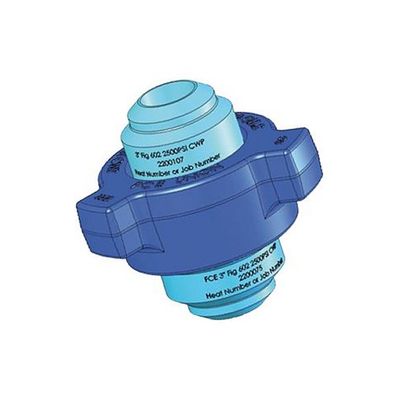
FCE - Wing Unions
Wing unions are also often referred to as hammer unions or hammer lug unions dependent upon the customer or manufacturer. Whatever name is used, they are the most common quick connection method for joining piping components together in a temporary system. FCE is one of the most reputed manufacturers of WING UNIONS approved by the major worldwide service companies. FCE products for oilfield services focus on Sour Gas service and most severe applications. In addition, FCE has developed WING UNIONS for various industrial market applications including gas bottling plants, pipeline maintenance services & loading systems in LACT units. FCE is also European leader in railcar couplings utilising specially modified wing unions.
Wing unions are one of the most common "quick connection" methods used in the oilfield for joining together components in a temporary pipe work system. They also have expanding applications in fixed installations and also for industrial purposes.
Male & Female subs:
They are the pressure containing parts of the assembly that provide metal-to-metal secondary seal. This ball-and-cone seal remains leak-proof even when one surface is slightly pitted or misaligned.
Subs are manufactured per different assembly modes:
- Butt weld assembly
- NPT threaded assembly
- NPST threaded assembly
- Sub profiles are also machined / forged as an integral part of a
piping element.
Nut:
This is a forged part of assembly that allows connection of the two subs through a specific Acme thread.
Seal Element:
Seal element is an elastomer component which acts as a primary seal to protect metal-to-metal seal against corrosion. Depending on the union figure it can be a lip type ”Seal Ring” or an ”O-Ring”. Different materials are available to suit fluid service (Buna for Standard service or Viton for H2S service).
NPST (Non Pressure Seal Thread)
The NPST assembly is a special design for Higher Pressure service which can replace welded or conventionally Threaded union construction.
In this instance it can be seen from the illustration that the threads are not exposed to well effluent which is the case with conventional threaded (ie L.P.) components.
This type of construction, on straight flowline and pup joints, is genreally more economically priced when compared to integral equipment.
SAFETY ALERT
Avoid the DANGER for interconnecting 2" Fig 602 and Fig 1002 with 2" Fig 1502.
Positively identify figure numbers and pressure ratings before connecting together 2 union halves.
Never strike, tighten, loosen or attempt repairs on pressurised components or connections.
Always apply essential care, handling and inspection to threaded components before, during and after make-up.
Never use severely worn, eroded or corroded components.
Never strike wing union nuts having severely flattened and extruded ears.
Always use a bronze hammer in order to avoid sparkling while striking onto a wing union nut.