


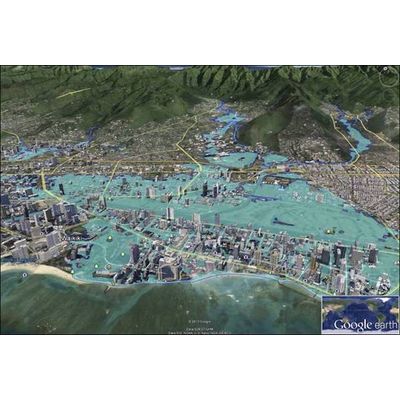
Ala Wai Flood Mitigation Project Consulting Services
The “Ala Wai Canal Flood Risk Management Project” was launched several years ago by the U.S. Army Corps of Engineers (USACE) to address the increasing risk of high-impact storm and flooding events in the Ala Wai watershed. Flash-flooding conditions can materialize within an hour in the upper portion of the Ala Wai watershed, creating significant damage downstream. USACE estimates a major flood in the watershed could damage 3,000 structures and cost more than $1.14 billion.
A project Feasibility Stage was initially completed in December 2017 when the Chief of Engineers for USACE submitted the Chief’s Report to Congress, but initial plans for an engineering solution were met with criticism from local and state stakeholders.
Oceanit was contracted by the Honolulu City Council, Permitted Interaction Group (PIG), as an environmental consulting interface for the City, the U.S. Army Corps of Engineers, and the local communities to assist with the Ala Wai Flood Mitigation Project.
The objective of the Ala Wai project is to improve safety from a low probability, high impact rain event by mitigating flooding in Waikiki and the Ala Wai Watershed valleys of Makiki, Manoa, and Palolo.
This climate project is of critical importance to protect the State’s primary university campus (UH Manoa), the economic engine that is Waikiki, and the neighborhoods of the watershed from the likely severe damage that a 100-year flood and storm event would cause.
The term “100–year flood” was coined to simplify the definition of a flood that statistically has a 1-percent chance of occurring in any given calendar year. Likewise, the term “100–year storm” is used to define a rainfall event that statistically has this same 1-percent chance of occurring. Read more about these terms here.
Stakeholder interaction during the early planning phases of the project was limited and created tension between the parties involved in executing the work, approving the work, and living in areas where work would affect daily life. Utilizing our Design Thinking methodology, Oceanit’s goal was to vastly improve the communication, cooperation, and understanding between all the stakeholders involved in this critical project. By hosting a series of community meetings, both in-person and virtually, we were able to build up conversation among diverse stakeholders, receive and integrate their feedback, and offer updated insights to the community, City, and USACE.
The U.S. Army Corps of Engineers (USACE) shifted from an initial detention model designed to retain water in detention basins in the middle watershed to a conveyance model that put more water in the lower watershed. This created concern within the community, especially from residents that would be affected. To address this concern, Oceanit listened to community input and developed the SWIFT (Subsurface Watershed Inundation Flow Technology) design concept to remove water from the watershed completely and bypass the Ala Wai Canal.
The SWIFT concept balances stakeholder priorities, which include protecting Waikiki at a reasonable cost without sacrificing our communities or ecosystems and bypassing the already delicate Ala Wai Canal.