

- Home
- Companies
- Eldan Recycling A/S
- Services
- Cable Recycling Services

Cable Recycling Services
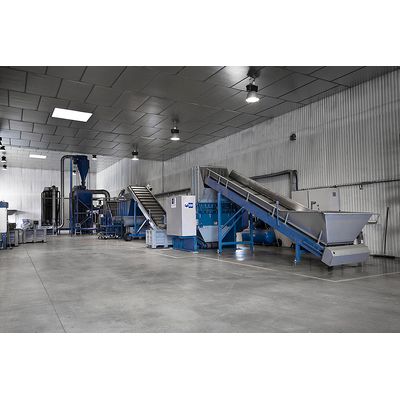
ELDAN Recycling has been active within cable recycling close to 60 years. What started with cable cutters, has expanded into including cable strippers, alligator shears and ACSR shears as well as machines and complete plants for processing of cables. Since copper and aluminium is 100% recyclable without loss of quality recycling of cable has always been a popular field. ELDAN Recycling and REDOMA Recycling form Eldan Group - a leading global supplier of equipment for profitable recycling. REDOMA offers small and medium-sized cable recycling plants from 150 kg/h up to 2000 kg/h while ELDAN focuses on high capacity recycling solutions from 2000 kg/h up to 10000 kg/h (for all kind of cable).
ELDAN has cable recycling equipment and solutions for processing of dry cables, jelly filled telecommunication cables and greasy underground cables. Depending on type of cable processed a final separation of at least 99.5% clean metal fraction of either aluminium or copper is obtained. The standard ELDAN setup includes a Rasper, a Granulator and a Separation Table – we have standard plants with capacities ranging from 200-4000 kgs/production hour. This is also the starting point when plants are tailored to suit specific customer requirements. These standard plants are the starting point when systems are tailored to suit specific customer requirements (e.g. production capacities from 6.000 to 10.000 kg/production hour, processing of ACSR cable or further reduction of metal losses).
REDOMA offers traditionally three types of cable recycling lines; Thunderhawk, Powerkat and Firefox. The standard setup includes a Rough Chopper, a Granulator and a Separator. All machines can be used as single machines or be integrated in different recycling plants for similar applications.
Input materials
In the different Eldan Cable Recycling Systems you will be able to process the following types of input:
Dry Cables
Dry cables usually have copper or aluminium conductors. The insulation is made of plastic, rubber or paper. Power cables may have steel or lead armouring which can be processed in our cable stripper and then process further in an Eldan Cable Recycling Plant. After granulation and separation the metal fraction will have a purity of up to 99.5%.
Dry cables which can be processed in an Eldan Cable Recycling Plant are e.g.: hair-wire, harness wire, communication wire, installation wire, power cables with copper or aluminium conductors, copper wire, ACSR-wire and mixed household wire.
Jelly Filled Cables
The aim of the recycling plant for jelly cables is to separate the copper and plastic fractions from jelly filled cables and to produce clean copper granules free from jelly. The separation works on a sink float principle (closed re-circulation) with gravity of insulation fraction of less than one. If the jelly cables were to have insulation or other objects with a too high specific gravity, it would be necessary to add to the end of the system either a wet separation table or a dry separation table to separate the copper and plastic fraction. The purity rate of the copper fraction will be approx. 88% depending on the material which is being processed. It will, however, be possible to obtain a purity rate of minimum 94% by adding to the Jelly Plant an Eldan Water Separation System and up to 99% by installing an additional Eldan Spinner Separator. Read more.
The Jelly Cable plant is environmentally safe meaning that it does not require any special certification or monitoring.
Underground Cables
Underground cables are heavy armouring cables consisting of a considerable amount of grease, plastics, paper and naturally lead and copper. What makes processing of underground cables so complex is the substantial amount of grease making the material stick together. Read more.
Output fractions
Depending on type of cables and size of plant the Eldan Cable Recycling System can give a final separation of at least 99.5% clean metal fraction of either aluminium or copper. The plastic fraction contains approximately 2-5% of metal. This fraction can then be further cleaned in a dry way with a Classifier and/or in a wet way on a Water Separation Unit.
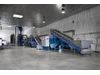
Example of standard set-up (E1000C): 1. Rasper, 2. Overband Magnet, 3. Fine Granulator (behind 5), 4. Silo (behind 5), 5. Separation Table
Example of standard set-up (E2500C): 1. Multi Purpose Rasper, 2. Overband magnet, 3. Fine Granulator, 4. Separation Table.
Example of standard set-up (E4000C): 1. Multi Purpose Rasper, 2. Overband magnet, 3a. Fine Granulator, 3b. Fine Granulator (behind 3a), 4. Separation Table.
Eldan Recycling offer standard and special systems depending on customer requirements in regards to e.g. type of input cable, production capacity and output size/quality. The systems have capacities ranging from 150-4,000 kg/production hour. These systems are also the starting point when tailoring solutions to customers - e.g. with higher capacities of 6,000, 8,000 or 10,000 kg/production hour.
The Eldan Cable Recycling systems are known for its high performance, yet low production costs. The solutions ensure minimum loss of metals and at least 99,5% metal purity in the output fraction. The systems and machines are developed based on ambient mechanical technique for size reduction and separation - i.e. no melting or chemical treatment is required.
An Eldan Cable Recycling System for dry cable processing will granulate and separate cables into metals (up to 99,5% pure) and plastics/organic.
Low and medium capacity solutions
- REDOMA Thunderhawk (150 - 450 kg/h). Mini-plant for cable recycling offers a simple and efficient chopping line for small recyclers with a limited budget. Read more here.
- REDOMA Powercat (500 - 700 kg/h). The Plant may be small in size, but it is full-grown in performance, yielding an exceptional purity of both metals and insulation. Read more here.
- REDOMA Firefox (1000 - 1700 kg/h). The plant stands for flexibility and superior technology. It is designed for medium-size companies and comes in several different models, depending on your required capacity. Read more here.
High capacity solution
As an example: in the standard system E4000C dry mixed copper or aluminium cables (recommended to be sorted) and PEX cables (≤Ø 115mm) can be processed at 4 ton/production hour producing granulated metals (up to 99,5% pure) and plastics/organic.
In the Eldan Jelly Cable Recycling System it is possible to process petroleum based jelly insulated telecommunication cables in an environmental friendly way. The solution offer high capacity as well as quality output. Using only established granualtion technologies and hot water in a closed re-circulating system, the plant easily seperates the steel, plastic and jelly - leaving only a clean copper product of high purity. The system includes a Pre-Granulator, a Fine Granulator, a Washing Unit, a Steam Generator and a Rotary Filter.
As an example: jelly filled cables (PE-cables) (max length 400 mm, max Ø80mm) can be processed at up to 1500 kg/production hour (depending on method of feeding, input material and required output size).
Eldan Recycling has developed a "small" capacity recycling system which give our customer a flexibility out of the ordinary - to process tyre, cable or/and WEEE (Waste Electrical and Electronic Equipment). We introduce to you the Eldan Multi Function-plant (E1500).
E1500T - Processing tyresThe Eldan tyre plant, E1500T is a simplified version of our larger tyre recycling plants. Like other Eldan solutions, this system is of modular design, which enables the possibility to add on to the system if required.
The system is simple, yet very effective, in order to minimize the number of machines and also space required. The E1500T only needs one operator for running the plant and one operator for handling the input tyres and and the output rubber granulate, textile and steel. The operation costs are low, due to the simple plant layout and the maintenance friendly machine design. The E1500T is the solution if you are looking for a less space-requiring, lower capacity tyre recycling plant.
The E1500T can process almost all types of tyres. As an example: processing truck and car tyres a 0-4 mm rubber granulate (95 – 99% free of liberated steel and textile) can be processed at approx. 1-1.5 ton/production hour.
D1500T – decreasing capacity, still processing tyresIf it is required to simplify the plant further, the Super Chopper and the inlet conveyor can be removed. The plant Is then called D1500T, and can process whole car tyres and pre-shredded truck tyres.
E4000T – increasing capacity, still processing tyresIf required, it is possible to further increase the capacity of the E1500T plant by upgrading it to an E4000T. The E4000T-upgrade includes adding a pusher, a stronger pump station, an additional Fine Granulator and a Classifier, buffer silos TBF and V4, among other additional machines. The E4000T can process up to 4 tons/processing hour, and produce an output of rubber granulate, 99.9% free of liberated steel wire and textile.
E1500TC - processing tyres and cablesThe E1500T can easily be modified to a tyre and cable recycling plant. By adding additional separation and classifying equipment it is possible to design the E1500 plant to be able to process tyres or cables in the same plant. The additional gravity separation table will separate the heavy copper granulate from the lighter plastic fraction from the cables. It only requires cleaning of the plant and diversion of the transport in the system to change from processing tyres to processing cables in the same Eldan E1500TC Multi function recycling plant.
E1500MF - processing tyres, cables and electronics/WEEEIt is possible to extend the E1500TC to also being able to process WEEE (Waste Electrical and Electronic Equipment) input as well as tyres and cables. As for the above described cable extension, the same plant can be expanded with the addition of a heavy duty Granulator and Eddy Current Separator and transports and the plant will now be able to process almost any type of input of tyres, cables or WEEE scrap materials.
This really shows the flexibility and advantage of the Eldan modular recycling plant concept. You could say that there are almost no limits for possible plant solutions, meaning that Eldan Recycling is able to fulfil any recycling requirements.
As a complement to the standard Eldan cable recycling systems, we offer optional modules to better suit your production requirements.
Increase plant capacityThe Super Chopper is a powerful, low-speed, single or dual shaft pre-chopper used for pre-chopping of the input material – partly to size reduce the input and partly to increase the capacity of the cable recycling plant.
Reduce metal losses - ClassifierThe Classifier (PC12) is used for recovery of the metals remaining in the plastic fraction. Reduction of the metal losses down to as little as 1%.
Reduce metal losses - Water Separation TableThe Water Separation Table is used for recovery of the metals remaining in the plastic fraction. Reduction of metal losses down to as little as 0,2%. Also enabling an increase of the capacity of the entire plant.
Peeling cablesCable Strippers are suitable for most cable types within the size range starting at 10mm and then =150mm.
Cutting cablesThe Alligator Shear is designed to cut metal bars and rods, electrical cables, coils and bundles of insulated and non-insulated wires. The max. setting (gap opening, outmost position) of the Alligator Shear is 160mm, cutting power of 40 tons.
For processing ACSR Cables (Aluminium Cable Steel Reinforced) on drums or reels.
The Water Separation System is a cost - effective solution to recover metal dust and fine wires from the plastic fraction after the metal separation. By using a well-balanced combination of water, table inclination and oscillating movements you will get an almost clean plastic fraction with metal losses as low as 0.2%. The metal fraction will have a purity of 98-99% (by weight) after drying of the metal. The water is cleaned through sedimentation and is recirculated in a closed system.
The Water Separation System is mainly used in the recycling of:
- Cables (aluminium and copper)
- Electronic and electrical waste (i.e. WEEE)