

- Home
- Companies
- Able Electropolishing
- Services
- Passivation for Chemical Cleaning ...
Passivation for Chemical Cleaning Process
Passivation is a chemical cleaning process that is designed to remove free iron and other ferrous contaminants from the surface of stainless steel parts. By removing the contamination from machining, stamping, etc., you are helping restore the material to the original mill condition and corrosion specifications. Passivation is ideal for many grades of stainless steel that have adequate levels of chromium and nickel, can help increase the longevity of many types of metal parts, and can also enhance their brightness.
Able Electropolishing has offered passivation since our founding in 1954 and we offer both citric and nitric passivation options. Note: parts that are electropolished are also passivated as part of the process, with the added benefit of being able to remove microscopic cracks, burrs and other imperfections. Many wanting passivation benefit much more from electropolishing while meeting passivation requirements.
Passivation is a chemical process designed to increase the corrosion resistance of stainless steel parts.
During the passivation process, parts are placed in a basket and submerged in a nitric or citric acid bath. Depending on the stainless steel alloy, the acid concentration, temperature and time are set to effectively remove free iron and other foreign materials on the part’s surface introduced during machining, stamping, and other processes. The passivation leaves the part clean and more corrosion resistant but does not change the aesthetics of the part.
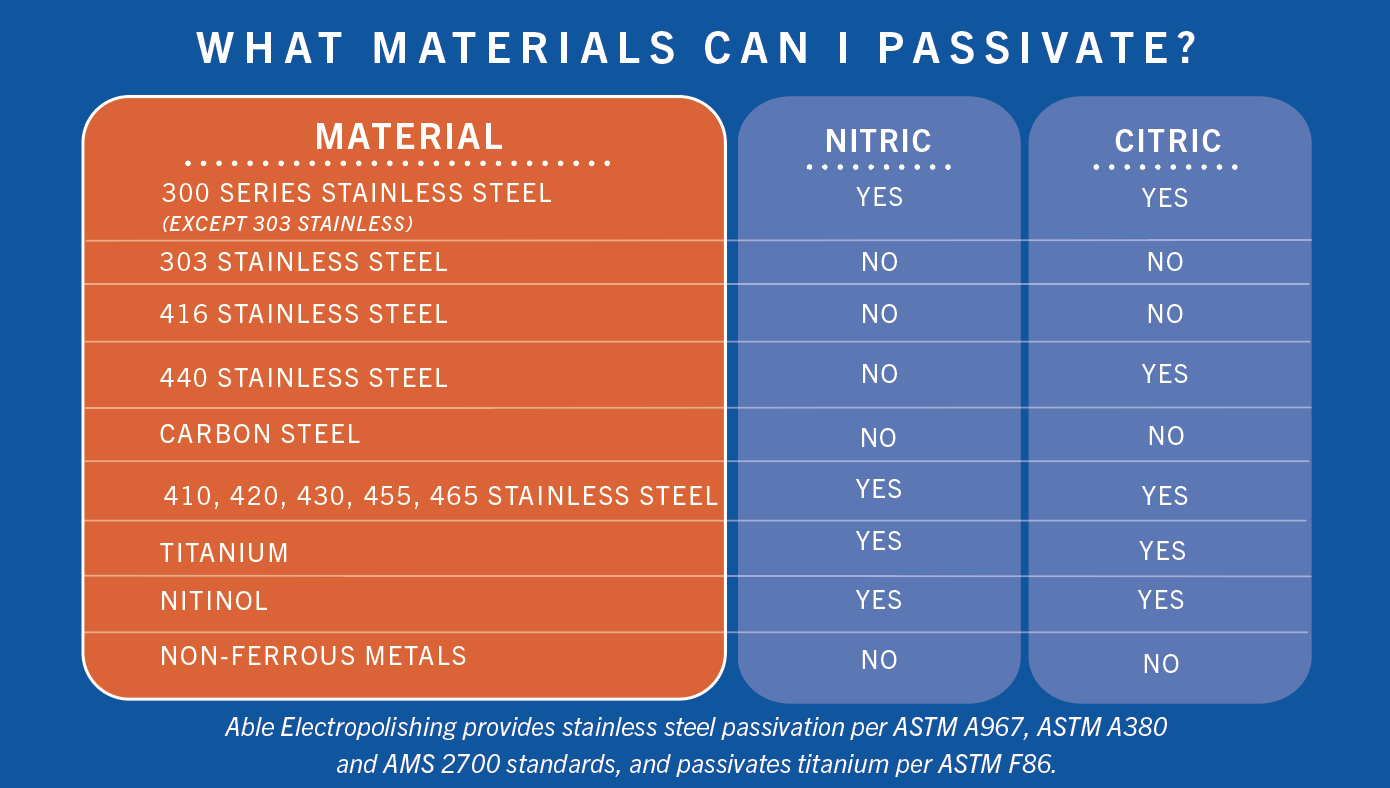
- Several popular grades of stainless steel should not be passivated due to low levels of chromium and nickel; when passivated, you run the risk of flash attack occurring which weakens the base material and does irreparable damage to the part
- Welded or brazed parts are not recommended for passivation; the process is not capable of removing the scale and discoloration in the heat-affected zone
- As an alternative to passivation, your part may be better suited for our proprietary Brite Passivation process, which involves a light electropolish and is a superior process to passivation for improving corrosion resistance
If improved corrosion resistance is the ultimate goal, passivation is an efficient process that parts can undergo, but passivation alone is not always effective at removing surface contaminants, and frequently requires an additional pre-cleaning step. However, electropolishing can remove all traces of surface and embedded contaminants in one operation.
Passivation is also only ideal for certain grades of stainless steel to remove free iron and other contaminants, but it isn’t recommended for some stainless steel grades that have insufficient levels of nickel and chromium. Welded or brazed parts are also incapable of undergoing the passivation process.
You can speak with an expert at Able Electropolishing to determine if your parts are ideal for passivation or other processes such as electropolishing. You may also find that your parts require more thorough microfinishing than passivation can provide.
Over the years, Able has been through the evolution of environmental compliance, waste minimization, recycling and water conservation. This outstanding job has earned Able a Certificate of Commendation from the Metropolitan Water Reclamation District of Greater Chicago.