


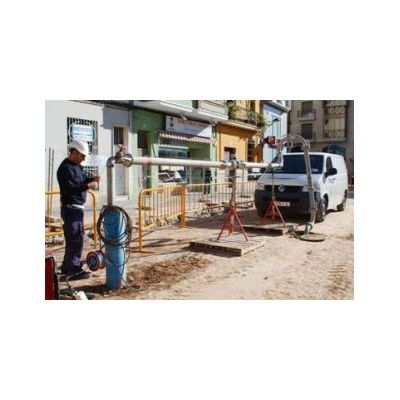
Pumping Test Service
In the past, rarely came prior to the job the study of the impact that groundwater might have on future construction to be carried out, both in the implementation period or on the finished job. In recent years, owners and technicians responsible recognize the importance of evaluating the impact on the work, because often determines the agenda of implementation and even determines the feasibility of it. The making of a series of tests or trials may determine the procedures for subsequent implementation to ensure the completion of the work.
Supplementary to geotechnical or soil mechanics studies, which it usually take place if the entity of the project so deserves, it should be made studies to identify other hydro geological parameters (Hydraulic Conductivity or permeability, transmissivity and storage coefficient).
Of the prospective studies to be undertaken, the results offered by pumping tests are by far, offering a closer approximation to the actual values, although that is the most costly, so that it is only justified if the entity of the work so requires. The incorporation of the latest technology in tracking flow and water table levels (magnetic meters, continuous and programmable electronic recorders) increase the accuracy of the results.
A pumping test generally require a well to be pumped, usually executed by a percussion or cable method, the diameter will be defined by the pump to install and the need to avoid the native soil corruption, particularly the permeability, as well as its efficient cost based on these premises. In addition it will be specified the execution of some observation wells or piezometers, usually made by rotation, which must be well developed and ensure that at the time of their use are found free from sludge.
We can not rule out other types of tests, lower in cost and accuracy, that are limited to approximate the values of permeability timely, such as known Slug Test, Lefranc, Gil-Gavard, Hvorslev or Cooper-Bredehoeft-Papadopoulos, among others , depending on the of the work itself that can be used when it is not warranted or not possible to implement a true pumping test.