


- Home
- Companies
- Water Technology Engineering Ltd. (WTE)
- Services
- Sewage Treatment Plant Maintanence
Sewage Treatment Plant Maintanence
Sewage Treatment Plant Servicing, Maintenance and Repair. A sewage treatment plant service costs from £75.00 for a 6 person system. Tel. 01757 289681 (Sapphire Environmental Ltd. Accredited Sewage Plant Service Engineers.). Sapphire services all makes including Klargester, Titan, WPL, Conder, Bio Pure, PureFlo, Biorock, Allerton, Acorn, Uni, Ensign, Entec, Moduline, etc. They are the sole UK maintenance engineers for BioKube and their service engineers are British Water Accredited.
A sewage treatment plant can solve many sewage disposal problems when no mains sewer connection is available. We can survey your individual site and advise whether a septic tank or a wastewater treatment unit would be the most suitable. There are always many factors to consider and from our experience we normally find that several different schemes can be considered.
Correct servicing also ensures that your treatment plant operates at its best, protecting the soak away system or watercourse at the point of discharge.
CORRECT SERVICE AND MAINTENANCE RECORDS FOR SEWAGE TREATMENT SYSTEMS ARE INSISTED UPON BY THE ENVIRONMENT AGENCY AND FORM A CONDITION ON THE DISCHARGE PERMIT.
Whatever sewage treatment system you install will require regluar servicing by a trained Sewage Treatment Plant Service Engineer, according to the manufacturers instructions. Systems which are not serviced regularly POLLUTE our streams and rivers and lead to prosecution by the Environment Agency. Please see the disaster photos on our sewage reports page.
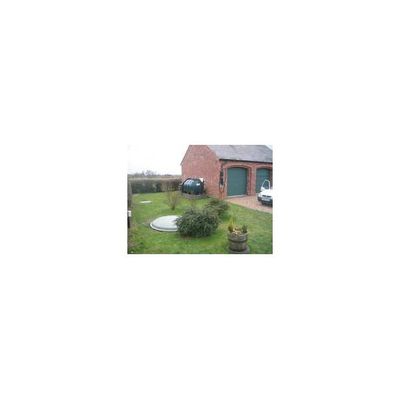
Full Sewage Installation service available, including gravelless soakaway systems as in the photo. Please ring for a quote.
ALWAYS insist on seeing the Service Engineers British Water Accreditation card.
NEVER ALLOW UNQUALIFIED PERSONS TO TAMPER WITH YOUR SEWAGE TREATMENT PLANT!
Services for sewage treatment systems start at £120.00 depending on the type of unit.
- DO try to stick to the same brands of cleaning products. Your unit will become quite tolerant to the brands you use.
- DO use liquids instead of powders e.g. washing and dishwasher. Liquids are kinder to the bacteria in the unit.
- DO spread out your washing through the week. Don’t have a ‘washing day’
- Consider using the `ALMAT` range of laundry and dishwasher detergents from ALDI. They contain no Phosphates and are environmentally friendly.
- DO consider washing with ‘Ecoballs’ * They work very well and contain no detergent or phosphates, great for your sewage unit (and for allergies)
- DO take out a maintenance contract. Only let experts look after your unit!
- DO try to use paper towels instead of cloths. By using paper towels to wipe down surfaces with anti-bacterials, the paper can go in the bin and NOT down the drains
Biological degradability of a substance is of paramount importance determining the potential pollution risks .
They can also affect the performance of biological treatment plants used for treatment of industrial and domestic wastewater.
If substances degrade easily in wastewater treatment plants, they will rarely have serious environmental effects, although, sometimes, the resulting products of the degradation might have environmental effects different from the original substance.
Substances which degrade only slowly, can present a risk as they tend to accumulate in the environment over time. The consequences of this build up of pollutants is, in some cases, still unknown. With this in mind, it can be taken as a general recommendation to avoid use of organic synthesised substances that are only slowly bio-degradable.
For surfactants, the primary degradation is very important.
Surfactants are substances that make water `Wetter` by breaking down the surface tension of water molecules. They can cause injury to plants and small organisms in the soil and watercourses, if they are not broken down first, as they affect the surface of the living roots and cells. Just as importantly, oils, grease and other particles in wastewater react with surfactants, and enzymes while they are traveling through sewage pipes from the source to the sewage treatment plant and form sludge.
These sludge materials can gather and coat the insides of the pipes, causing blockages, but can also clog the media in the sewage treatment plant.
Primary degradation means that the substance loses its original structure and properties e.g. its surface activity. This means that the potentially negative effects in the treatment plants and in the water and soil environment are reduced significantly.
In a wider environmental perspective the complete degradation naturally is of importance.
If you look at the label of any dishwasher tablet or any laundry powder, you will find non degradable ingredients which are persistent and do not break down or become digested by the bacteria in a septic tank or sewage treatment plant.
These are, typically, polycarboxylates, phosphonates and or optical brighteners.
Here is the link to the DID list european ecolabel for persistant chemicals and check for yourself. These ingredients are publicly marked as persistent as indicated with PÂ in the DID list.
Ecover never uses any such persistent chemicals in its formulations and, in fact, chooses ingredients which maximize the speed of bio-degradation.
They only incorporate readily biodegradable ingredients which degrade faster than inherently degradable ones.
Ecover uses only two inherently degradable (ie slower) cellulose derivatives.
Another relevant difference is that Ecover never used any ingredients that do not degrade in anaerobic conditions such as the settling part of the treatment system
This is more difficult to check for yourself and requires checking the ingredient declaration of mainstream brands on their website.
Any sulfonated surfactant used in many mainstream laundry and toilet products as well as some dish washing liquids does not degrade in anaerobic conditions.
It is very easy to make your own cleaning products that are kind to the bacteria in your sewage system.
You may like to try some of these recipes:
- Bathroom Cleaners:
- Toilet Bowl Cleaners:
- Baking Soda and Vinegar: Sprinkle baking soda into the bowl, then squirt with vinegar and scour with a toilet brush. Cleans and deodorises.
- Borax and Lemon Juice. For removing stubborn stains, like rings round the toilet bowl Flush the toilet to wet the sides ,, mix borax and lemon juice into a paste then rub it on. Leave it tor 2 hours and scrub thoroughly
- 1 cup borax, 1/2 cup white vinegar. Flush to wet the sides of the bowl. Sprinkle the borax around the toilet bowl, then spray with vinegar. Leave for several hours or overnight before scrubbing with a toilet brush.
- Denture tablets are an excellent substitute for toilet cleaner. Drop two tablets into the bowl and clean as you would with toilet cleaner.
- Mix liquid soap and baking soda or Borax, apply to the bowl and scrub with a toilet brush.
Drain Cleaner:
For slow drains, use this c Irain cleaner once a week to keep drains fresh and clog-free.
- 1/2 cup baking soda
- 1 cup white vinegar
- 1 gallon boiling water
- 1/2 a used lemon
Pour baking soda down drain/disposal. followed by vinegar . Allow the mixture to foam for several minutes before flushing the drain with boiling water.
Bath and Tile Cleaners
- Baking Soda. Sprinkle baking soda like you would scouring powder. Rub with a damp sponge. Rinse thoroughly.
- Vinegar and Baking Soda. To remove film buildup on bathtubs, apply vinegar full-strength to a sponge and wipe. Next, use baking soda as you would scouring powder. Rub with a damp sponge and rinse thoroughly with clean water.
- Vinegar. Vinegar removes most dirt without scrubbing and doesn`t leave a film. Use 1/4 cup (or more) vinegar to 4 litres of water.
- Baking Soda. To clean grout, put 3 cups baking soda into a medium-sized bowl and add 1 cup warm water. Mix into a smooth paste and scrub into grout with a sponge or toothbrush. Rinse thoroughly and dispose of leftover paste when finis! led.
- Rub the area to be cleaned with half a lemon dipped in borax. Rinse well, and dry with soft cloth.
Porcelain Cleaner
Cream of Tartar. To clean porcelain surfaces, rub with cream of tartar sprinkled on a damp cloth.
Plumbing Fixtures:
- To clean stainless steel, chrome. fiberglass. ceramic , porcelain or enamel fixtures, dissolve 2 tbsp baking soda in 1 qt of water. Wipe on fixtures then rinse.
- Vinegar and Paper Towels. Hard lime deposits around faucets can be softened for easy removal by covering the deposits with vinegar-soaked paper towels, Leave the ! paper towels on for about one hour before cleaning. Leaves chrome clean and shiny.
Shower Heads:
1) Metal Shower Heads:
To remove deposits which may be clogging your metal shower head, combine 1/2 cup white vinegar and one quart water.
Then completely submerge the shower head and boil 15 minutes.
2) Plastic Shower Heads:
Combine 1 cup white vinegar and 1 cup hot water. Completely submerge the shower head and soak for about one hour.
Rust Stain and Hard Water Deposit Remover:
- Apply full-strength vinegar or lemon juice and let stand until spot disappears, rinse. Repeat if necessary.
- Mildew Remover - Dissolve half-cup vinegar with half-cup borax in warm water.
- Lime Deposits - White vinegar