


- Home
- Companies
- Heijmans Blackwell Remediation Ltd
- Services
- Soils Washing Services
Soils Washing Services
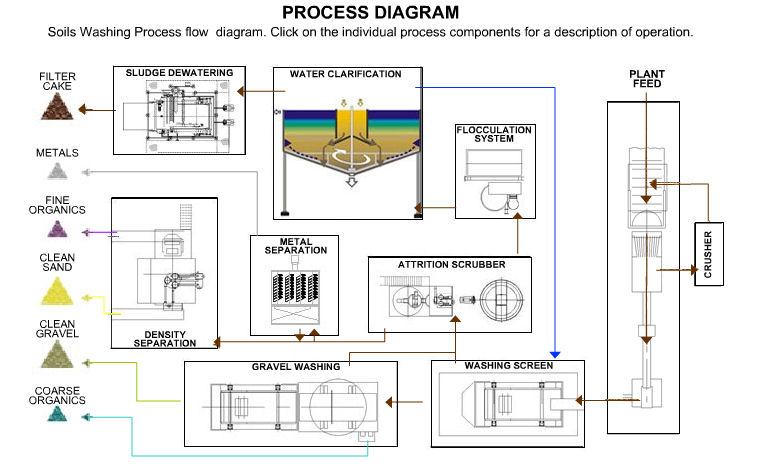
We cemented our reputation for undertaking challenging large scale remediation projects by successfully completing a number of complex soils washing contracts in the UK. Soils washing is a water based exsitu volume reduction technology for the treatment of contaminated soils. It employs a wide ranging set of wet separation, scrubbing and cleaning steps to physically, mechanically and chemically manipulate and separate soil particles from absorbed and particulate contamination. It is thereby able to recover a bulk volume of cleaned gravel, sand and silt material for reuse.
Our first major UK soils washing project was undertaken in 1997, at Basford Gasworks. Remediation works were completed under a Linatex / Heijmans joint venture the precursor to the formation of HBR in the UK washing over 150,000 tonnes of heavily hydrocarbon impacted soils to permit reuse of cleaned soils on site. Subsequently, HBR soils washing plant and operators were mobilised to the former Arjo Wiggins Paper Manufacturing site in Lincolnshire, where some 4.5 tonnes of mercury and over 25 tonnes of zinc were removed from the washed feedstock.
As demonstrated by the above examples, soils washing can be employed to remediate both organic and inorganic contaminated soils.
HBR have continued to lead the field in terms of innovation and research in soils washing technology over the last 10 years, with several large and prestigious contracts being successfully completed on sites exhibiting a range of contaminants.
Crucially, our operators benefit from a huge amount of experience gained both in the UK, as well as within Europe, where we have successfully treated soils impacted with the following:
- fibrous asbestos
- particulate metals
- ogano-tins
- pesticides
- hydrocarbons
- inorganic contaminants
- organic matter
To date, over 2 million tonnes of soil have been processed in HBR installations. Our latest project utilised two HBR plants to treat >250,000 tonnes of made ground soils at the Northern Hub Treatment Centre, Olympic Park, London. These plants were custom fitted with bespoke equipment to remove problematic particulate metals from the cleaned gravel and sand factions, allowing the client maximum flexibity in material reuse across the park.
Our washing plants are closed loop (recycling process water) modular systems that can be configured with various separation steps (attrition scrubbers, density medium separation, hydrocyclones, drum magnets etc) to meet the requirements of each project, where we assess each site by looking at the soil type (PSD curves, clay type ect), as well as the contaminants and their form. This is typically achieved by reviewing existing site data as running our own in-house benchscale studies to ensure we maximise treatment efficiency, predict recover volumes, optimise polymer flocculation, and assess water treatment requirements.
We have recently added to our fleet by building in-house a smaller more mobile plant capable of 2,500 tonnes/wk. This unit is suited to projects requiring rapid mobilisation, smaller working footprint and soils exhibiting lower percentages of fines (demolition waste, railway ballast). It is also applicable on larger projects requiring initial pilot trial work.
All our systems employ either belt press or plate press dewatering modules to produce a filter cake, which can be further treated biologically or using stabilisation reagents.