


- Home
- Companies
- Angst+Pfister
- Services
- Solution Testing & Validation
Solution Testing & Validation
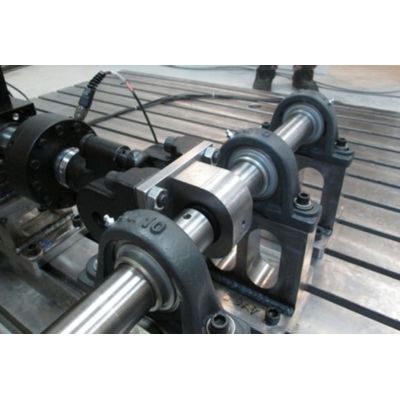
Angst+Pfister specializes in advanced engineering solutions, offering a comprehensive range of services and products tailored to meet the strictest technical requirements. Their engineering capabilities encompass thorough solution testing and validation processes, using cutting-edge technologies to simulate real-world conditions and ensure product durability and performance. Techniques like multi-axis dynamic testing, high-frequency evaluations, and environmental simulations ensure products withstand demanding environments. Complementing these are surface treatments, such as sandblasting and zinc coating, enhancing bonding and corrosion resistance. Extensive testing methods, including force-deflection, bonding strength, ozone resistance, and creep testing, are employed to certify material reliability. Furthermore, ongoing investment in high-frequency testing accommodates the evolving demands of industries, such as electric vehicles, where vibration and noise are critical concerns. By employing Finite Element Analysis in product design and optimizing material formulations, Angst+Pfister delivers high-performance, customized solutions backed by a global network of technical support.
Using advanced technologies, we simulate real-world conditions to ensure every product meets the highest standards of durability and performance. Our capabilities include multi-axis dynamic testing, high-frequency evaluations for electric vehicles, and environmental tests like low-temperature (TR10) and ozone resistance.
Complementing these are advanced surface treatments such as sandblasting and zinc coating, enhancing bonding and corrosion resistance. With force-deflection, bonding strength, and creep testing, we guarantee reliability over time. Angst+Pfister’s commitment to excellence ensures solutions that meet the toughest challenges with unmatched precision and reliability.
Key Competences at One Glance
- Thorough Durability Assurance: Advanced technologies like multi-axis dynamic testing and environmental simulations ensure that products meet high durability and perform well under real-world conditions.
- Precise and Consistent Quality Control: Extensive tests such as elongation, compression, and ozone resistance for sealing guarantee consistent performance..
- Optimized Performance for Emerging Demands: High-frequency elastomer testing and advanced bonding strength testing ensure our components address current challenges and are future-ready, especially for industries like electric vehicles.
Precision at Every Step – The Process of Sealing Testing
Elongation Testing
Elongation at break, tensile strength or modulus can be precisely measured. This enables us to guarantee the performance of the seals itself and consistent quality overall. These testing machines are used in all our production facilities.
Compression Testing
Elastic recovery after being exposed to compression, a so-called compression set device is used. A sealing element can be placed within an autoclave and compressed for specifically defined periods of times, and in certain temperatures and contact media. The deformation is then measured, which can serve as a quality indicator.
Ozone Testing
Especially unsaturated polymers such as NBR, NR or SBR can develop cracks when deformed and used in normal ozone concentrations found in the daily environment. The resistance to ozone cracking can be considerably increased by the addition of special ozone-protection additives. During the ozone test, a sample is exposed to a specific ozone concentration while being stretched for a given percentage and time period. Once the test duration reaches the defined time period, the specimen is visually inspected for cracks. If no cracks are detected, the sample passes the test.
Low-Temperature Testing (TR10):
The TR10-value is the temperature at which a specimen that was stretched by 25% or 50% at room temperature, then recovers by 10% after gradually de-freezing it from a temperature below its glass transition point. Furthermore, this test shows the progressive defrosting behavior and the temperature dependent elasticity of the rubber material. For this reason, the TR-10 test is one of the most informative cold tests for O-rings and many other sealing applications.