


Sonic Drilling
Sonic drilling is a unique innovative technique for environmental, geotechnical, construction, seismic and mineral applications.
How Does Sonic Drilling Works?
Sonic drilling employs an inertially activated drill head which generates high-frequency sinusoidal vibrations to advance a core barrel or casing into subsurface formations producing no spoils from the drilling process. During drilling, the resonant energy is transferred down the drill string to the bit face at various sonic frequencies. The resonant energy is generated inside of the sonic head by two counter-rotating weights. A pneumatic isolation system inside the head prevents the resonant energy from transmitting to the drill rig and preferentially directs the energy down the drill string.
Compact Sonic
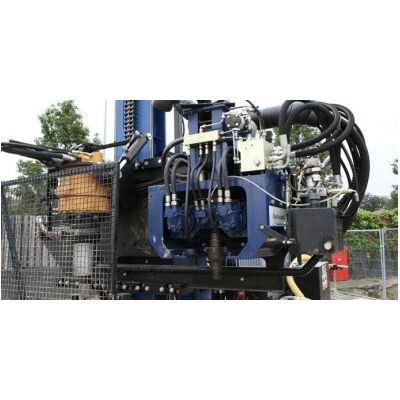
Ecologia’s drilling rig is equipped with a compact sonic head. The heart of this head consists of two eccentric weights with a mass of 7 kg each that are driven by two high-speed hydraulic motors, (6-12,000 rpm). High frequency vibrations (100-200 Hz) are generated in the head and then transferred to the drill rods. The high frequency vibrations cause the soil surrounding the drill rods to fluidise. The soil is fluidised only in the immediate proximity (1-5 mm) of the drilling rods/sampler. This reduces friction and allows the drill rods to quickly penetrate soils comprised of unconsolidated clays, silts, sands, and gravels. The sonic head incorporates an integrated rotational drilling motor facilitating super fast coupling and de-coupling of the drill rods along with soil formation and concrete coring. This drilling motor cannot be used simultaneously with the sonic head, requiring the operator to select one function at a time. The Sonic head is housed in a frame isolated by rubber buffers, eliminating the transfer of energy to the rig.
Ecologia JOY 4 Hybrid Rig
In order to cater for the competitive market of geo-environmental site investigation and to provide the greatest possible range of applied drilling techniques to our clients, Ecologia took the unprecedented step of combining the compact sonic drilling technology with a conventional rotary rig in order to create a Hybrid system which allows in-field switching between techniques. This enables our drilling crews to switch from fast, clean sonic drilling in non-cohesive soils to conventional flight auger or flushed rotary techniques in a matter of minutes, dependent on ground conditions, with none of the additional downtime or re-mobilisation costs that might occur with a conventional machine.
Our Hybrid Drilling Rig is fully equipped with a variety of different tooling to cope with a massive range of geological and site-specific constraints.
The Compact Sonic System is designed to run a large variety of down-hole tooling to:
- Create boreholes for injection, seismic and geo-construction applications
- Collect soil, groundwater and vapour samples
- Install permanent monitoring points, multi-channel, pre-pack and geothermal wells
Sonic Drilling Tools
A range of casings and piston samplers allows Ecologia to perform virtually spoil-free, ultra-fast drilling and sampling of sands, gravels, soft clays and heavily weathered rock. The Aqualock™ sampler system allows continuous or spot sampling with almost 100% recovery for environmental site investigations, allowing for rapid and accurate contaminant plume delineation, sampling and geological logging from a single borehole.
The Aqualock System
aqualock square Sonic DrillingThe Aqualock is a patented sampling method that really comes into its own when used in conjunction with the compact Sonic head. The sampler that comes in 2-metre lengths is dropped to its required depth at the same speed as with the lost cone method. For the penetration the space within the Aqualock sampler is filled with water which keeps the piston down at the bottom end, therefore there is no drilling cone involved. When the required depth has been reached, the water is allowed to escape towards the drilling rods above.
The sonic vibrations make it possible to achieve an undisturbed core where generally only the outer layer (1 to 2mm) is affected by the vibrations. Samples can be taken from clay as well as from (coarse) gravelly sand. The sampler can be lowered down the previously drilled hole and at the new depth another sample can be taken. This involves repeatedly inserting and extracting the drilling rod meaning that sampling is achieved very easily and rapidly with this method. Finally, with the aid of the water the sample is pressed out of the sampler into a trough or a plastic liner.