

- Home
- Companies
- Filtermax Filtration Services Limited
- Services
- UV Reactive Filter Leak Testing With ...
UV Reactive Filter Leak Testing With Reactolite Powder
During the operational life of installed filter media in a dust collector, it is frequently found that levels of emission have risen to an unacceptable level, yet often the majority of filters within the installation are known to be intact and in good condition.
Invariably, these sporadic failures are as a result of abrasion of the filter elements against each other or the adjacent walls of the equipment, or from flexing of the filter media against the support cage.
Other causes can be localised heat or sparks, the misalignment or progressive loosening of filters against seals, or frequently the accidental introduction of sharp objects into the system.
It is often impossible to locate or identify the failed unit(s), thus conventionally requiring a complete, but unnecessary filter change to restore the original level of performance.
To overcome this problem, and to avoid the potential expense of a major refurbishment, Micronair Engineering have the facility for locating each individual failure by the injection of a UV reactive fluorescent dye - "REACTOLITE" - into the system.
The test consists of the introduction of a calculated amount of fluorescent dye into the system whilst the main fan is briefly operational.
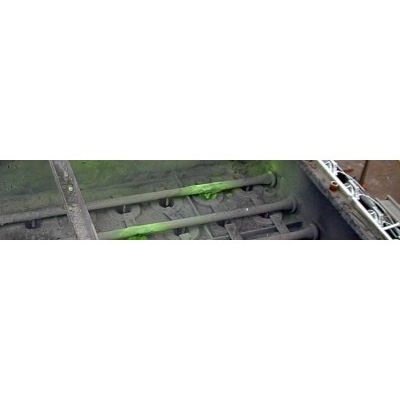
The system is then closed down and the clean side of the filter is then scanned with a UV light source. The leaks are clearly identified by the "REACTOLITE" fluorescing wherever it has emerged - even in the most microscopic quantities.
When the leakage is located and remedied, a second test with a contrasting "REACTOLITE"dye may be carried out to confirm that the remedial work was successful. This may be particularly relevant where the dust being collected is potentially harmful.
Although the product is guaranteed to be totally safe with regard to handling and ingestion, it may be considered more appropriate to utilise the DOP Test where the introduction of a fluorescent product into a process would be inconvenient or unacceptable.