


- Home
- Companies
- Flow Science, Inc.
- Software
- Flow Science - Version FLOW-3D CAST - ...
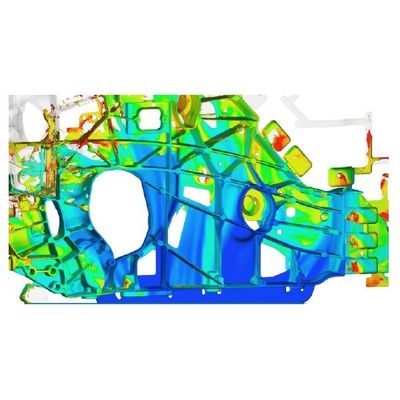
Flow Science - Version FLOW-3D CAST -High Pressure Die Casting Workspace
The High Pressure Die Casting Workspace is an intuitive modeling environment designed to help engineers successfully model high pressure die casting applications with FLOW-3D CAST. Full control of shot sleeve motion, combined with advanced die thermal control, machine parameter modeling, and accurate resolution of fill and backpressure conditions make FLOW-3D CAST the reference solution for the most demanding HPDC simulation needs. In addition to advanced porosity prediction and post-processing functionalities, the HPDC Workspace includes a state-of-the-art chemistry-based solidification and material strength model for Al-Si and Al-Cu based alloys.
- Extraordinary fill accuracy
- Full process modeling includes advanced venting, PQ2, and spray cooling
- Dynamic simulation control allows dynamic runtime process control
- State-of-the-art aluminum silicon alloy solidification
FLOW-3D CAST‘s defect tracking capabilities help casting engineers predict where surface oxide defects are most likely to occur from the filling process. Oxides form due to an exposed molten metal surface to air and can end up in the part in undesirable locations. The final location of the defects depends on the overall flow conditions, turbulent mixing, fluid jetting and impingement. FLOW-3D CAST accurately tracks these oxides and their final locations to help improve designs.
PROCESSES MODELED
- High pressure die casting
FLEXIBLE MESHING
- FAVOR™ simple mesh generation tool
- Multi-block meshing
- Nested meshing
DIE THERMAL MANAGEMENT
- Thermal die cycling
- Heat saturation
- Full heat transfer modeling
- Smart cooling channel control
- Spray cooling path modeling
ADVANCED SOLIDIFICATION
- Porosity prediction
- Shrinkage
- Hot spots identification
- Mechanical property prediction
- Microstructure prediction
LADLE MOTION
- 6 degrees of freedom motion definition
VACUUM AND VENTING
- Interactive probe placement
- Area and loss coefficient calculator
FILLING ACCURACY
- Slow and fast shot modeling
- Intensification pressure effects
- Gas and bubble entrapment
- Surface oxide calculation
- RNG and LES turbulence models
- Back pressure
DEFECT PREDICTION
- Macro and micro porosity
- Gas porosity
- Early solidification
- Oxide formation
- Surface defect analysis
SURFACE DEFECT ANALYSIS
- PQ2 analysis
- Probe based triggers
- Heat controls
- Vacuum and venting controls
COMPLETE ANALYSIS PACKAGE
- Animations with multi-viewports - 3D, 2D, history plots, volume rendering
- Porosity analysis tool
- Side-by-side simulation results comparison
- Sensors for measuring melt temperature, solid fraction
- Particle tracers
- Batch post-processing
- Report generation