


HYDRUS - Microsoft Windows Program for Simulating Water Flow and Solute Transport
A Microsoft Windows Program for Simulating Water Flow and Solute Transport in Two- and Three-Dimensional Variably Saturated Media.
New Features and Changes (related to GUI):
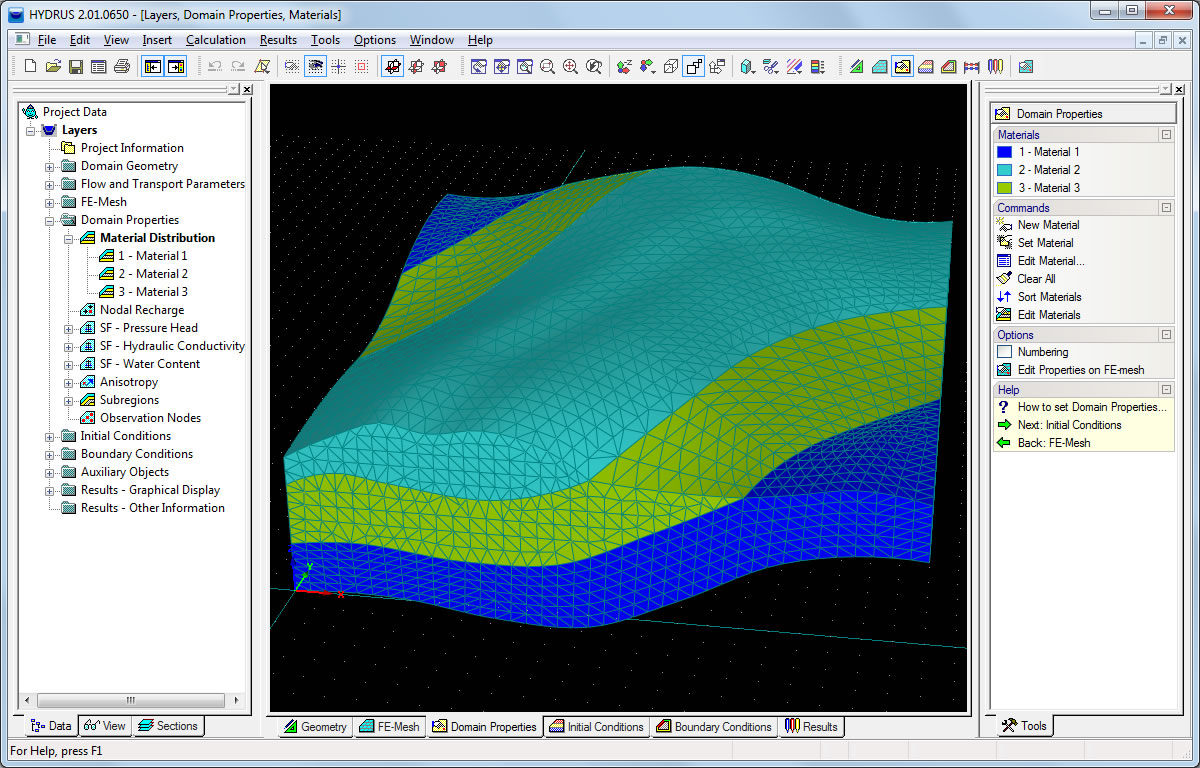
- Support for complex General three-dimensional geometries (3D-Professional Level).
- Domain Properties, Initial Conditions, and Boundary Conditions can be specified on Geometric Objects (defining the transport domain) rather than on the finite element mesh.
- New FE-mesh generator for unstructured 3D meshes. Supports mesh refinements and stretching.
- Background layers facilitating graphical input of data.
- Import of geometry and background layers from a number of formats (DXF, STL, TIN, BMP, ...)
- Import of various quantities (e.g., domain properties, initial and boundary conditions) from another HYDRUS projects even with (slightly) different geometry or FE mesh.
- Support of ParSWMS (a parallelized version of SWMS_3D).
- Support of UNSATCHEM (a module simulating transport of and reactions between major ions).
- Support of a new CWM1 constructed wetland module.
- The Mass Balance (Inverse) Information dialog window enables to display texts larger than the capacity of the Edit window.
- Constructed Wetland Parameters commands added to the main menu and navigation tree.
- Root distribution can be specified using GUI parallel with the slope of hillslopes.
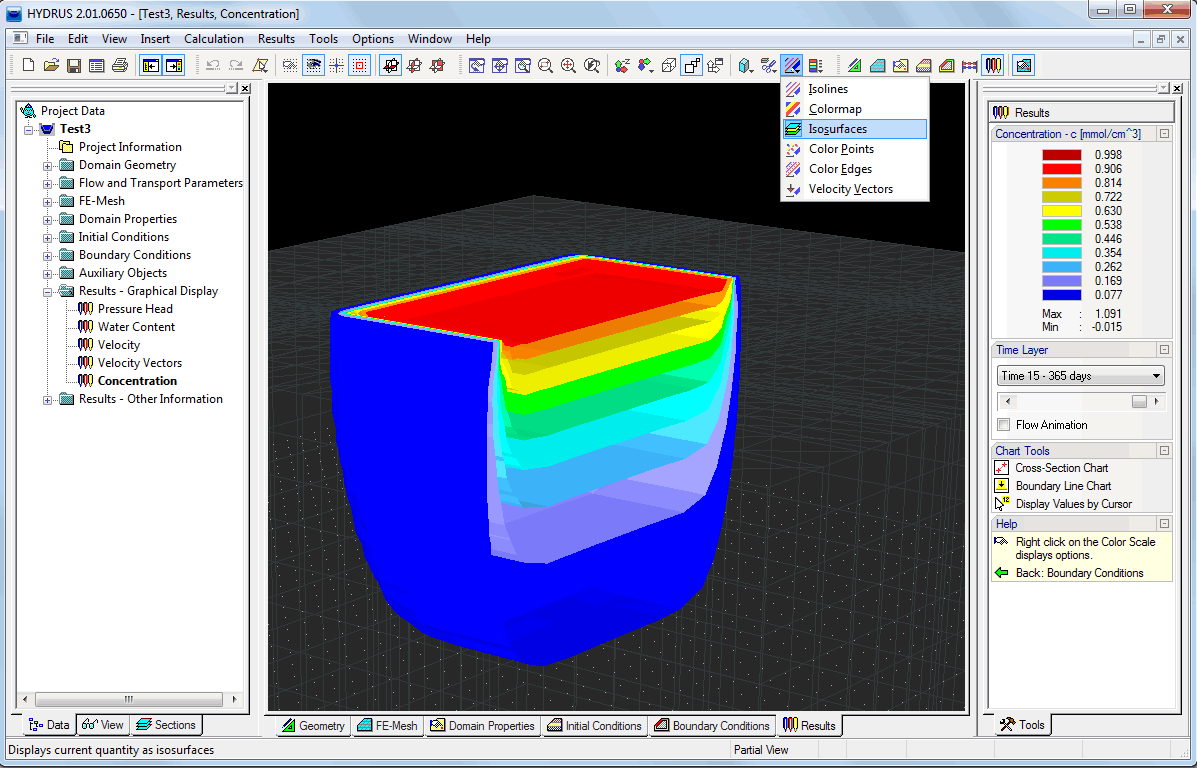
- Display of results using Isosurfaces.
- On-line activation and deactivation. HYDRUS 2.x can be activated and/or deactivated via internet without asking for activation codes.
New Features and Changes (related to computational modules):
- New, more efficient algorithm for particle tracking. Time-step control to guarantee smooth particle paths.
- Initial conditions can be specified in the total solute mass (previously only liquid phase concentrations were allowed).
- Initial equilibration of nonequilibrium solute phases with equilibrium solute phase (given in initial conditions).
- Gradient Boundary Conditions (users can specify other than unit (free drainage) gradient boundary conditions).
- A subsurface drip boundary condition (with a drip characteristic function reducing irrigation flux based on the back pressure).
- A surface drip boundary condition with dynamic wetting radius.
- A seepage face boundary condition with a specified pressure head.
- Triggered Irrigation - irrigation is triggered by HYDRUS when the pressure head at a particular observation node drops below a specified value.
- Time-variable internal pressure head or flux nodal sinks/sources (previously only constant internal sinks/sources).
- Fluxes across meshlines in the computational module for multiple solutes (previously only for one solute).
- HYDRUS calculates and reports surface runoff, evaporation, and infiltration fluxes for the atmospheric boundary.
- Water content dependence of solute reactions parameters using the Walker’s [1974] formula was implemented. (Walker, A., A simulation model for prediction of herbicide persistence, J. Environ. Quality, 3(4), 396-401, 1974.)
- An option to consider root solute uptake, including both passive and active uptake [Šimunek and Hopmans, 2009].
- The Per Moldrup’s tortuosity models [Moldrup et al., 1997, 2000] were implemented as an alternative to the Millington and Quirk [1960] model.
- An option to use a set of Boundary Condition records multiple times.
- Executable programs are about 1.5 - 3 times faster than in the standard version due to the loop vectorization.
- A new CWM1 constructed wetland module (in addition to the CW2D module).
- New options related to the fumigant transport (e.g., removal of tarp, temperature dependent tarp properties, additional injection of fumigant).
Fixed Errors:
- Fixed error: The Wetland module had a wrong format statement when writing the CumQ.out file.
- Fixed error: FE-mesh generation could fail if stretching factors were >1 and the domain boundary contained polylines and (at the same time) splines or arcs.
- Fixed error: Activation energy coefficients in the temperature dependence functions were incorrectly converted when time units changed.
- Fixed error: Unit conversion of the area associated with transpiration was incorrect when length units changed.
- Fixed error: Conversion of some first- and zero-order rate constants with respect to length units.
- HYDRUS 2D/3D installation program has been optimized for Windows Vista
- Colors for graphical display of Materials, Sub-regions and Anisotropy can now be customized within the groundwater model HYDRUS 2D/3D
- New option for importing domain geometry from a text file in HYDRUS 2D/3D; there is a new key word that allows for the import of thickness variables with multiple sub-layers with variable thickness into the groundwater model
HYDRUS 2D/3D is a Windows based modeling environment for analysis of groundwater flow and solute transport in variably saturated porous media. Computational finite element models are included in HYDRUS 2D/3D for simulating both 2D and 3D transport of water, heat and solutes in variably saturated media. A parameter optimization algorithm is also available in HYDRUS 2D/3D for inverse modeling of soil hydraulic and/or solute transport parameters. HYDRUS 2D/3D is also supported by an interactive graphics-based interface for data pre-processing, generation of structured and unstructured finite element mesh, and graphic presentation of the result