- Home
- Companies
- Geophysical Insights
- Software
- Paradise - Detect Faults Automatically ...
Paradise - Detect Faults Automatically Software
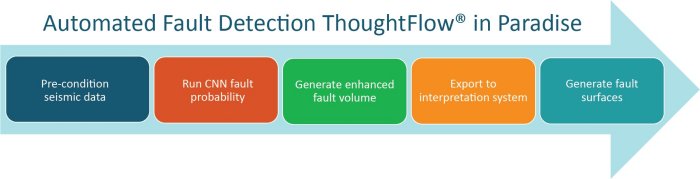
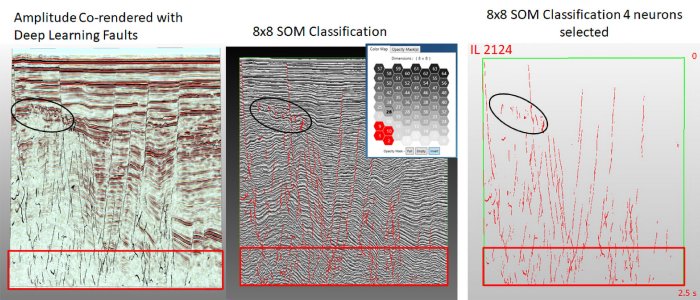
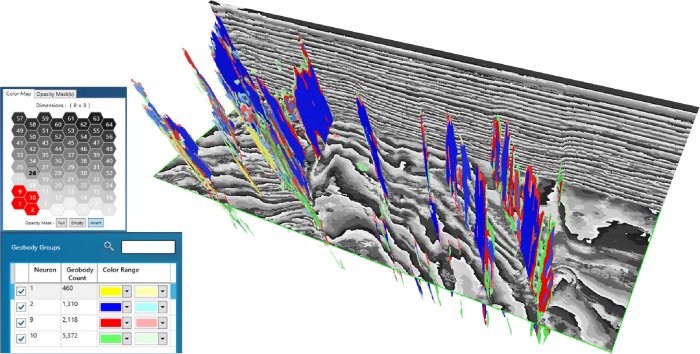
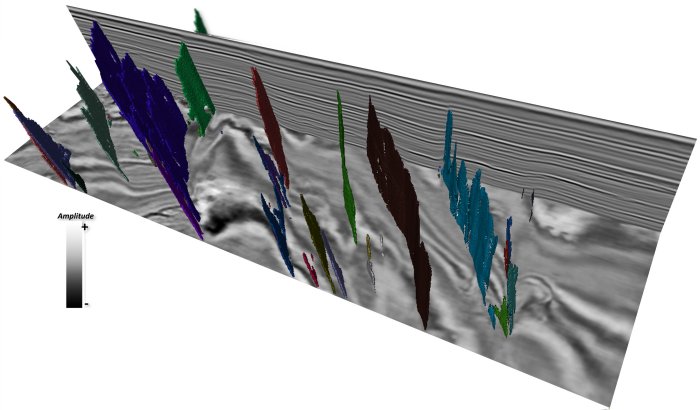
Interpreters spend a lot of time identifying faults in seismic data by picking 2D sections from a 3D seismic volume. This critical process can now be automated with AI Fault Detection in Paradise®, which uses deep learning and machine learning processes to generate fault volumes for fault interpretation. Check out the short video to the right to see results from AI Fault Detection, including for complex fault regimes or noisy seismic data. More examples of Fault Detection results are shown below. Select the technical papers below to learn more about fault interpretation and automatic Fault Detection.
Built on 3D CNN technology, the Deep Learning (DL) Fault Detection application is equipped with robust synthetic fault models supporting a wide range of seismic data. Since the fault models are pre-trained, geoscientists are not required to pick lines, avoiding bias and the computational training cost. AI Fault Detection uses a combination of supervised Deep Learning (DL) and unsupervised Machine Learning (ML) technologies to produce a refined fault volume, ready to import into an interpretation system and generate fault planes. Fault Detection offers these advantages:
- Pre-trained, robust 3D synthetic fault model – dramatically saves compute time
- Frees geoscientists from having to pick faults manually – eliminates bias
- Rapid conversion of fault probability results
- Eliminates uncertainty in manually selecting faults to build a valid machine-learning model
- Enables semi-supervised machine learning fault interpretation