


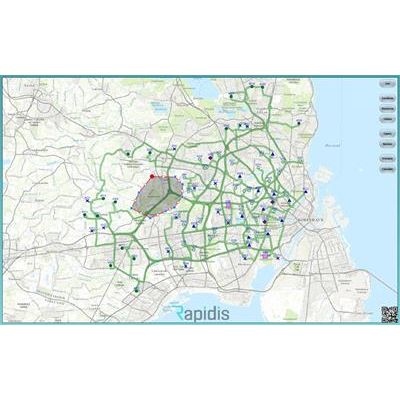
Rapidis - Scheduling and Routing Software for Demand Responsive Transport (DRT)
Passenger transportation that is not covered by scheduled bus routes; also known as Demand Responsive Transport can be both school busses, paratransit, medical trips and more. A request for transport will, in this field, consist of both a pickup and a delivery. In the morning a student is picked up at her home address and brought to her school, institution or perhaps a treatment facility. Later, the same day, the same transport is often carried out in reverse order.
At first glance one may consider scheduling drive orders like this as assigning pickups and deliveries to every bus in the fleet so that each bus will do as little driving as possible.
However, in real life there is a number of considerations that the planner needs to do; how many minutes is passenger X allowed to travel, are passengers X and Z allowed to travel in the same bus at the same time or is there enough space in bus no. 58 to pick up passenger Y and his wheelchair at location 79?
Rapidis offer an edition of the Logistics Planner software dedicated to route planning and scheduling in Demand Responsive Transport.
Travel time for each passenger is minimized
Most municipalities and agencies offering demand responsive transport to citizens have strict rules for how the service level should be. A great example is limitations to the travel time for a passenger. Rapidis Logistics Planner will route plan a fleet of busses making sure that no passengers will spend more time in the bus than allowed. The limit can either be a fixed number of minutes or it could be defined as the direct path (if the bus drives the passenger from A to B with any other stops in between) with an addition of an arbitrary number of minutes.
Every single minute that a passenger travels is regarded a cost in the Rapidis Algorithm making sure that travel time for each passenger is kept as low as possible.
Advanced use of time windows
A time windows describes the time span in which a pickup or a delivery must take place. Time windows can be used in a simple way or you may add more complexity if necessary. Let´s imagine that a delivery task has a time window 07.45 – 08.00. You may now decide if it is OK that the bus arrives within the time window or if also all delivery tasks must be completed within the time window.
”Early pickup” and ”late delivery” are both functionalities that help making the trip more convenient for the passengers. If a passenger has an appointment for treatment at 10.00 and a corresponding time window for delivery 09.0 – 10.00 you may want to flag the “late delivery” option to force the Logistics Planner to plan this trip in a way that allows for this passenger to arrive as close to 10.00 as possible and thereby minimizing wait time at the hospital – off course with little or no increase in the total costs of transportation.
Order GroupsEvery drive order may also be labeled with an order group.
Order groups are then used to decide what passengers are allowed to be in the bus at the same time and also who are not allowed to ride together.
Usage possibilities are countless, but one example could be a municipality offering transportation to both children going to school and to the elderly going to treatment. In this case the planner can easily keep the two groups apart if so desired. At the same time, it may be of interest for find out how different rules for who can travel together or not, will affect to costs of transportation.
Passengers assigned to demand responsive transport may need the secure feeling of being transported by a drive known to them. This demand for “fixed driver” is often very difficult to guarantee; any driver has a sick day now then and, like everybody else, drivers also need vacations.
For all these reasons the Logistics Planner works with ”resource groups”. All drivers can be members of different resource groups and a resource group may have as many members as you want. The idea is that any given drive order can demand a driver from a specific resource group. Securing not a specific driver, but at least a “familiar face”. This will make the route planning much more efficient and, at the same time, realistic and fulfilling to the need of the passenger.
Capacities and LoadDemand Responsive Transport is characterized by buses picking up and delivering passengers during the route. Rapidis Logistics Planner will keep track of how the capacity of each bus is utilized at all times. This is important so that each bus actually has available seats and room for wheelchairs etc. when arriving to pick up one or more passengers. Multiple capacities
Download at use case story explaining how the Danish Transportation Authority uses Logistics Planner for daily scheduling and route planning for school bus routes and other demand responsive transport jobs.
Who uses Logistics Planner DRT?-
School- and Paratransit bus operators
-
Municipalities with daily DRT planning
-
Institutions planning or operating DRT busses
-
Analysts making calculations prior to tenders
-
Transportation Authorities
-
As a webservice – REST API. Covers Europe, USA, Canada, Australia and New Zealand. More countries will be added upon request
-
As an extension for ArcGIS
-
Integrates with costumer systems
-
Pr. unit subscription pricing
-
Contact us for details and test
-
Improved passenger convenience
-
Travel distance, travel time and number of vehicles is reduced
-
All plans meet restrictions and constraints
-
Faster planning – complete plans in minutes
-
10 – 30 % cost reductions on key figures