


- Home
- Companies
- Flow Science, Inc.
- Software
- Flow Science - Version FLOW-3D CAST - ...
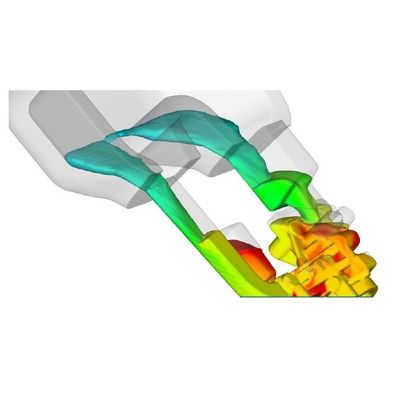
Flow Science - Version FLOW-3D CAST -Tilt Pour Casting Workspace
In this FLOW-3D CAST simulation of an 8-cavity tilt pour casting, A356 aluminum is poured at 738 C by rotating the mold from a horizontal orientation to a vertical orientation over 18 seconds. The H13 steel mold is thermally prepared by simulating 5 cycles of fill/solidify/spray cooling using FLOW-3D CAST’s thermal die cycling model.
The Tilt Pour Casting Workspace is an intuitive modeling environment designed to help engineers successfully model tilt pour casting applications with FLOW-3D CAST. The workspace includes process-specific die and material types, where rotational motions are easily defined in order to match exact machine capabilities. Venting and backpressure are included in the fill analysis for a complete analysis of air entrapment defects, while thermal die cycling and state-of-the-art solidification models are seamlessly connected to the fill through the workspace’s sub-process architecture. The Tilt Pour Casting Workspace provides a complete and accurate solution for all aspects of the simulation in a simple yet versatile modeling environment.
PROCESSES MODELED
- Tilt pour
- Reverse tilt pour
FLEXIBLE MESHING
- FAVOR™ simple mesh generation tool
- Multi-block meshing
- Conforming meshing
DIE THERMAL MANAGMENT
- Thermal die cycling
- Heat saturation
- Full heat transfer modeling
ADVANCED SOLIDIFICATION
- Porosity prediction
- Shrinkage
- Hot spots identification
- Thermal modulus
- Mechanical property prediction
SAND CORES
- Core gas evolution
- Material definitions for core properties
MOLD MOTION CONTROL
- Six axes of rotation
- Tabular input for rotational velocities
DEFECT PREDICTION
- Macro and micro porosity
- Gas porosity
- Early solidification
- Oxide formation
- Surface defect analysis
DYNAMIC SIMULATION CONTROL
- Event probe-based triggers for motion control
COMPLETE ANALYSIS PACKAGE
- Animations with multi-viewports - 3D, 2D, history plots, volume rendering
- Porosity analysis tool
- Side-by-side simulation results comparison
- Sensors for measuring melt temperature, solid fraction
- Particle tracers
- Batch post-processing
- Report generation