

- Home
- Companies
- Chemtronics Technologies (India) Pvt. ...
- Applications
- International airports & train stations ...
International airports & train stations indoor air quality treatment solution - Air and Climate - Indoor Air
These are collectively known as“SICK BUILDING SYNDROME”. To address Sick Building Syndrome (SBS) the AHU systems take “Outdoor Air” to dilute Volatile Organic Compound (VOC) and reduce Carbon dioxide (CO2) within acceptable limits. Conventionally Fresh Air is used to improve Indoor Air Quality (IAQ). Fresh air is not cheap! Hot and humid air needs to be cooled down to room temperature.
Load profile of fresh air
- 60% to cool moisture … wasted energy
- 28% to cool nitrogen …..wasted energy
- 12% to cool oxygen …..the only useful component in fresh air.
“Energy Consumption- 150 CFM of Fresh Air will require 1ton of cooling load. (Approximately)”
“ASHRAE approves reduction in fresh air, if chemical contaminants in air are removed”.
We refer you to the following sections of ASHRAE62-99:
“Procedure for use of cleaned recirculated air: The amount of outdoor air may be reduced by recirculating air from which offending contaminants have been removed or converted to less objectionable forms. Formaldehyde, for example may be oxidized to water and carbon dioxide. The amount of outdoor air depends on the contaminants generated in the space, etc ......”.
ASHRAE Standards
- ASHRAE Ventilation code no. 62-1999.
- Minimum 15 CFM per person fresh air is required.
- Minimum of 30 CFM fresh air is required if smoking is permitted.
How to reduce “Fresh Air”
- By using controlled injection of ozone.
- Oxidation of Volatile Organic Compound (VOC) is performed by ozone and not by oxygen of the fresh air.
- Ozone is more powerful oxidizing agent than oxygen.
- In the presence of a more powerful oxidant, less powerful oxidant does not have the chance to perform oxidation, until no more of the former is available.
- Oxygen of the fresh air is preserved and not spent in performing the task of oxidizing the Volatile Organic Compound (VOC), which is now transferred to ozone.
- Available oxygen is now used entirely to maintain Carbon-di-oxide.
- Intake of fresh air is reduced drastically. Thus fresh air requirement goes down to 5CFM or less per person.
Controlled Ozone is increasingly being used in Airports to improve the indoor air quality & also to achieve the energy efficiency of the HVAC systems.
Dubai International Airport could be the largest Ozonated HVAC System using Air Treatment in all the buildings installed by an international firm. There are many small Ozone Generators installed in HVAC ducts along with Ozone Sensor, VOC Sensors. All the interior spaces in the airport are treated with Ozone Generator.
Ozone Generators are the best technology to improve indoor air quality in air ports, train stations and also can reduce smoke odor, food odor effectively.
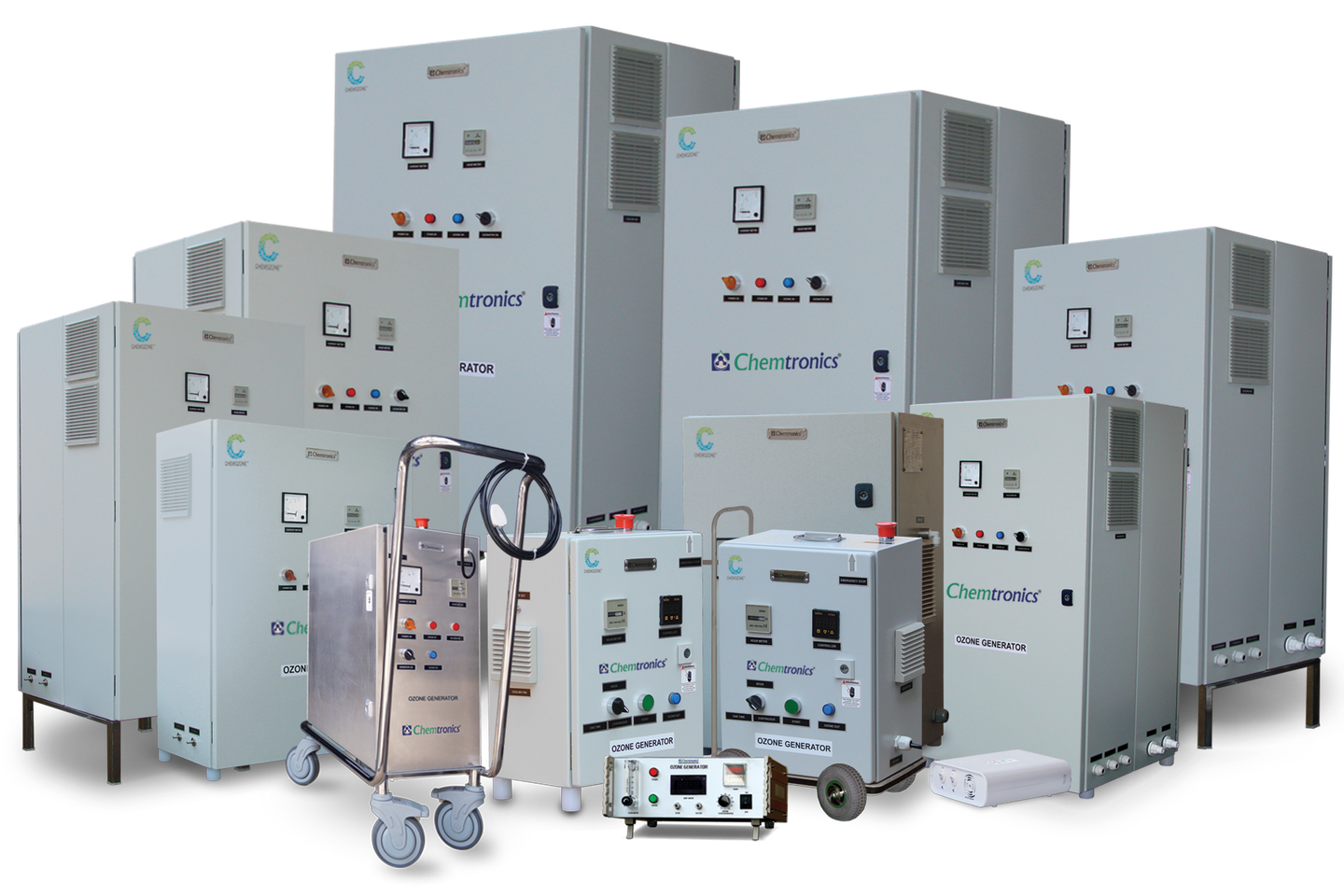
Chemtronics has successfully designed and installed oxygen fed air Ozone Generator to integrate with the present HVAC system. It achieves acceptable Indoor Air Quality (IAQ) while minimizing energy consumption, and fully complying with ASHRAE standards. It also helps in getting LEED rating points on Indoor Air Quality. This unique technology integration gives buy back of CapEx in less than 2 year.