


- Home
- Companies
- Dispersion Technology, Inc. (DTI)
- Applications
- Zeta Potential - Monitoring and Testing ...




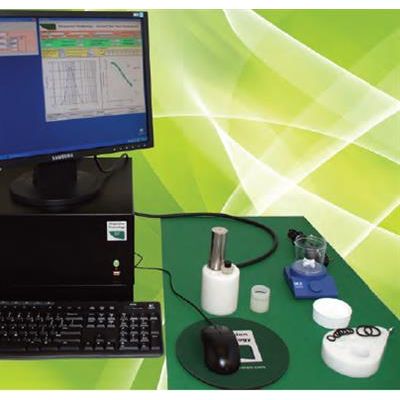
Zeta Potential - Monitoring and Testing - Laboratory Equipment
Zeta potential is a parameter characterizing electrochemical equilibrium at interfaces. It depends on the properties of both the surface and the surrounding liquid. It plays an important role in the theory of aggregative stability, also known as DLVO theoElectric potential decays almost exponentially, which allows introduction of the “Debye length“ as an estimate of the DL thickness. Electric potential drops by approximately 2.7 times at the distance from the surface that equals to the Debye length. Debye length depends mostly on “ionic strength” of the liquid. It is approximately 1 nm at an ionic strength of 0.1 M, and it increases as a reciprocal of the square root of ionic strength (electrolyte concentration) becoming, for instance, 10 nm at an ionic strength of 0.001 M.
There is another characteristic distance within DL: the location of a slipping plane associated with tangential motion of the liquid relative to the surface. The liquid inside of the slipping plane remains attached to the surface, whereas the liquid beyond the slipping plane moves with the surrounding liquid. The electric potential at the slipping plane is what is referred to as “Zeta potential.” It is measured in millivolts (mV), with a maximum absolute value of 100 mV in aqueous solutions, according to International Standard ISO 13099, Parts 1: 2012 “Colloidal systems – Methods for Zeta potential determination”.
Calculation of Zeta Potential from the parameters measured by zeta potential analyzers requires appropriate theory.There are two important asymptotic cases when analytical theories exist. The most known case is that of a “thin DL”, which corresponds to particulates with DLs that are much thinner than their particle radius. The vast majority of aqueous dispersions satisfy this condition, except for very small particles and low ionic strength media. Calculation of Zeta Potential can be performed using the “Smoluchowski theory” when surface conductivity is negligible.
The opposite asymptotic case is that of a “thick DL,” which corresponds to systems where the DL is much larger than the particle radius. The vast majority of dispersions in hydrocarbon media, which inherently have very low ionic strength, satisfy this condition.
These two asymptotic cases allow one to picture, at least approximately, the DL structure around spherical particles.
There is one more important factor affecting DL structure: the so-called “overlap of DLs”. Increasing volume fraction and/or reduction of the particle size brings particles surfaces close and eventually diffuse layers would overlap. This overlap of Double Layers might become important for nano-particles, macro-molecules, proteins, etc[6]. It is definitely important in non-polar liquids, within which double layers extend quite far and are therefore more likely to overlap. This overlap of Double Layers is also important in in porous materials[7][8].
There are more details can be found in the JUPAC report on Electrokinetic phenomena[9], as well as on Wikipedia[10]. An overview of the different methods of Zeta Potential measurement can be found in our book[11].
INTERNATIONAL STANDARDS.
International Standard ISO 13099-1, 2012 “Colloidal systems – Methods for Zeta potential determination- Part 1: Electroacoustic and Electrokinetic phenomena”:
- REFERENCES.
Derjaguin , B.V. and Landau, L., “Theory of the stability of strongly charged lyophobic sols and the adhesion of strongly charged particles in solution of electrolytes”, Acta Phys. Chim, USSR, 14, 733 (1941) - Verwey, E.J.W. and Overbeek, J.Th.G., “Theory of the Stability of Lyophobic Colloids”, Elsevier (1948)
- Lyklema, J. “Fundamentals of Interface and Colloid Science”, Volumes 1, Academic Press, (1993)
- Hunter, R.J. “Zeta potential in Colloid Science”, Academic Press, NY (1981)
- Dukhin S.S. and Derjaguin B.V. “Electrokinetic Phenomena”, Surface and Colloid Science, Ed. E. Matijevic, John Willey & Sons, NY, (1974)
- Dukhin, A.S. and Parlia, S. “Measuring zeta potential of protein nano-particles using electroacoustics”, Colloids and Surfaces B, 121:257-63 (2014)
- Dukhin, A.S. and Shilov , V.N. “Seismoelectric effect.: A non-isochoric streaming current. 2. Theory”, J. Colloid and Interface Science, 346, p.248-253 (2010)
- Dukhin, A.S., Goetz, P.J, and Thommes, M. “Seismoelectric effect.: A non-isochoric streaming current. 1. Experiment”, J. Colloid and Interface Science, 345, p.547-553 (2010)
- Measurement and Interpretation of Electrokinetic Phenomena (IUPAC Technical Report), 2005
- Wikipedia.Zeta_potential
- Dukhin, A.S. and Goetz, J.P. “Characterization of Liquids, Nano- and Microparticulates, and Porous Bodies using Ultrasound”, Edition 3, Elsevier, 571 pages, 765 references, (2017).