


Coping with the daily challenges of routine water analysis
A high number of samples already presents a challenge for laboratories. Once this number reaches the point where it is not possible for a single analyst to carry out all determinations of one type, slight differences in the results will appear as each lab member treats the sample slightly differently. More analysts working on the routine samples introduces more bias, and this can be plainly seen in the variability between results.
Due to the sheer number of samples to be analyzed on a daily basis,automation is the keyin order to deal with all of these obstacles. The goal is to automate the routine application process as much as possible, includingsample preparationas well as thecombination of different techniques within one systemto make the workload easier. Most drinking water samples must be analyzed forconductivity,pH, andalkalinity. Sample throughput is always a very important consideration for water quality laboratories. Therefore, analyses should be carried out in parallel to save time because of the high sample load.
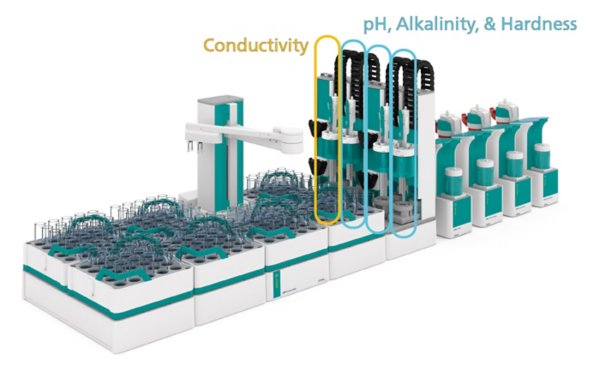
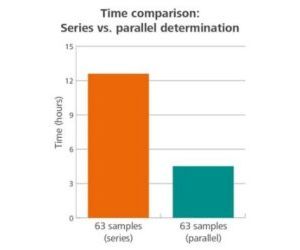
Based on the previous example, it is obvious that the described instrument setup can result in significant time savings. In fact, up to 64% of analysis time can be saved by automating and running determinations in parallel rather than in series.
This figure is based on the fully automated determination of conductivity, pH, alkalinity, and hardness for 63 samples. Running these four determinations on just one sample requires 12 minutes as shown below. When run in series, this results in more than 12.5 hours, while parallelization can reduce the time needed for these analyses to 4.5 hours (64% time savings).
Analysis type: Duration
1 sample: 12 minutes
Series: 63 samples: 12 hours 36 minutes
Parallel: 63 samples: 4 hours 31 minutes
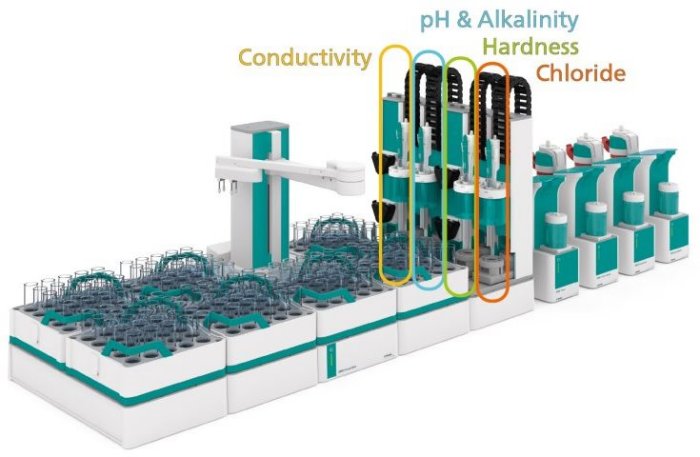
For example, the system shown here holds four dedicated workstations for the determination ofconductivity,pH and alkalinity,water hardness, as well aschloride. In this way it is ensured that each sensor is handled and stored in the most suitable way. Additionally, influences from one analysis to another can be completely avoided. With this system setup, a sample is either prepared separately for each station, or it can be passed from one station to the other.
No matter whether you are interested in determining several parameters or just one or two specific ones, an automated system such as OMNIS from Metrohm can be tailored to your needs and requirements. If these change after some time and more detailed ion analysis becomes necessary for example, then ion chromatography can be easily added to the existing system setup. Less sample volume is needed as it is no longer necessary to split it into several aliquots for measurement on different instruments.