

- Home
- Companies
- Hiden Analytical Ltd.
- Articles
- Real-time soil CO2 monitoring at ...
Real-time soil CO2 monitoring at Stromboli using HPR-20 R&D
Stromboli Island hosts one of the world’s most monitored volcanoes, equipped with a comprehensive multi-parameter surveillance system for 24/7 monitoring, early warning of eruptions, and detection of slope failures with potential tsunami generation. Real-time, high-frequency gas measurements enable detection of subtle shifts in CO2 flux and gas ratios that may reflect magma ascent, pressurisation, and changes in conduit permeability. When integrated with seismicity and ground deformation data, these geochemical signals form a critical component of multi-parameter early-warning systems for forecasting eruptive activity and identifying instability linked to potential flank collapse. The volcano-gas monitoring system is managed by INGV, specifically the Etneo and Vesuvius observatories, in coordination with the Civil Protection Department.
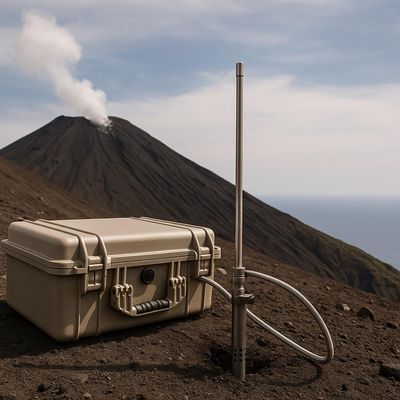
In May 2023, Jim Melling and Aldo Conti of AC Scientific, the Hiden Analytical representative in Italy, installed a HPR-20 R&D system on Stromboli to monitor soil CO2 levels on the slopes. Sampling is conducted via a custom 1-metre stainless-steel tube with perforated intake at the bottom; the tube is driven into the ground at the sampling point, and the sample line is inserted and sealed. The data from this installation augment the volcano’s monitoring to provide early warning of explosive activity.
The HPR-20 R&D is engineered for continuous, real-time analysis of volcanic gas, water and sediment, with ppb-level sensitivity and sub-second temporal resolution. This enables capturing transient geochemical signals with high fidelity, supporting volcanological research and real-time monitoring in challenging field environments. In volcanic settings like Stromboli, robust inlet design and uninterrupted sampling are essential to resolving short-lived degassing transients and diffuse CO2 anomalies against a geochemical background.
Complementary instruments are deployed to broaden analytical coverage. The portable pQA system provides field-deployable, battery-powered mass spectrometric analysis for on-site characterization of volcanic emissions; the QGA 2.0 offers high-precision quantitative gas analysis with enhanced stability for long-term monitoring; and the HPR-40 MIMS enables direct, real-time analysis of dissolved gases in aqueous environments, valuable for studying volcanic lakes, hydrothermal systems, and groundwater or sediment gas fluxes. When used together, these instruments enable cross-validation of gas compositions across diffuse soil degassing, fumarolic emissions, and dissolved volatile phases within a unified framework.
This integrated approach supports high-resolution spatiotemporal correlation of geochemical signals, improving interpretation of subsurface magmatic processes and strengthening the reliability of early-warning indicators for eruptive activity and related instability.
Original: https://www.hidenanalytical.com/blog/real-time-soil-co2-monitoring-at-stromboli-using-hpr-20-rd/?utm_source=rss&utm_medium=rss&utm_campaign=real-time-soil-co2-monitoring-at-stromboli-using-hpr-20-rd