

ABM Sensor Technology
- Home
- Companies
- ABM Sensor Technology
- Articles
- Ultrasonic Level Sensor Working ...
Ultrasonic Level Sensor Working Principle
Nov. 29, 2023
Courtesy ofABM Sensor Technology
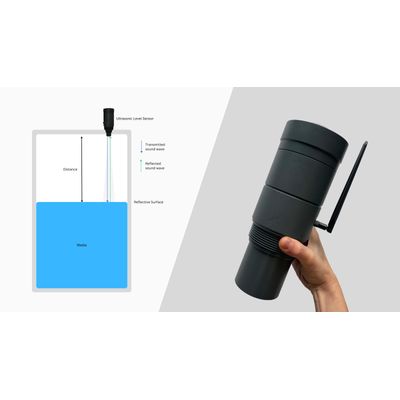
An ultrasonic level sensor is a device that utilizes sound waves to measure the level of a substance, such as a liquid or solid material, in a tank, container, bin or vessel. It is a continuous level measurement device that provides real-time, non-contact measurement.
The basic working principle involves transmitting a short pulse of ultrasonic sound from the sensor and measuring the time it takes for the sound wave to travel to the target and back. The time-of-flight is then used to calculate the distance.
Here is the step-by-step process:
- A pulse transmitter stimulates an ultrasonic transducer (a device that converts electrical energy into mechanical vibrations and vice versa) matched to air, generating a sound wave.
- The wave propagates through the air to the surface of the target and then reflects back towards the sensor.
- The reflected wave is received by the same transducer in the receiver mode and converted to an electrical signal.
- The electrical signal is amplified and processed to find the reflected echo.
- The sensor captures the difference in time between the emitted and received echo.
- Distance to the target is calculated using the speed of sound, a known variable, and the round-trip time as shown in the following equation:Distance = Time x Speed / 2
- Where division by two is required as time measurement is round-trip (to the target and back)
- The calculated distance is converted linearly to 4 mA to 20 mA current. Optionally, information can be sent via RS232 or RS485 to a PC for processing such as diagnostics, programmable set-up and data logging.
Propagation of Ultrasonic Sound Waves
- Speed of sound is 343 m/s at 20°C (68°F)
- The speed of sound through air depends on temperature (the most significant factor), pressure and humidity
- Material with a different density and speed of sound than air reflects ultrasonic waves
- Hard surface, high-density materials give good reflections, such as water
- Soft surface, low-density materials give poor reflections, such as foam (permeable targets absorb more reflected ultrasonic energy)
Learn more about ABM’s non-contact ultrasonic level sensors here.
Most popular related searches