

- Home
- Companies
- EWT Eckert Wassertechnik GmbH
- Products
- Ion Exchange Dealkalisation
Ion Exchange Dealkalisation
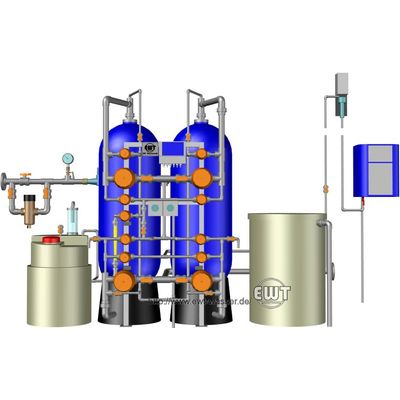
Dealkalisation (also: dealkalization) is an ion exchange process for partial demineralisation of water by exchanging certain calcium and magnesium ions for hydrogen ions. For dealkalisation, water flows through a vessel filled with weak acid cation exchange resin in hydrogen form. This results in an amount of calcium and magnesium ions which is chemically equivalent to the alkalinity of the that water to be exchanged for hydrogen ions. The hydrogen ions then react with hydrocarbonate to carbonic acid, and further to water and carbon dioxide. For removal of that carbon dioxide, a CO2-degasser is often used downstream of a dealkalisation plant.
Dealkalisation is a discontinuous process. The ion exchange resins eventually deplete, and then need to be regenerated with either a hydrochloric acid or a sulfuric acid solution. A certain amount of acidic effluent is produced with each regeneration. Compared to other ion exchange processes, dealkalisation requires significantly less regeneration chemicals; the chemical demand is in fact almost stoichiometric.
- Boiler feed water treatment: Dealkalisation of the →make-up water, usually followed by a →softening plant.
- Recirculating cooling water treatment: Dealkalisation of the →make-up water.
- Beverage industry: Dealkalisation of product water and service water.
- Dealkalisation of →reverse osmosis feed.