


- CPT - Crawler-Truck Type CPT Rigs
- CTP - Crawler-Based CPT Rigs
- CTP - Truck-Based CPT Rigs
- CPT - CPT Rigs with Anchoring
- CPT - CPT Penetrometer Rigs (Other)
- CPT - CPT Base Kit
- CPT - Data Acquisition & Processing
- CPT - Electrical CPT/U - Piezocone
- CPT - Special Modules for CPT
- CPT - Mechanical CPT
- CPT - CPT Tubes
- CPT - Push-and-Pull Clamps
- CPT - Soil Sampling and Drilling
- CPT - CPT Accessoires
- SPT & DPT Equipment - DPT and SPT Rigs
- SPT & DPT Equipment - Hammers
- SPT & DPT Equipment - Rods, Tips and Heads
- SPT & DPT Equipment - Soil Sampling Tubes
- SPT & DPT Equipment - Pulling Devices
- SPT & DPT Equipment - DPT and SPT Accessories
- Instrumentation
- Accessories
Gouda Geo-Equipment B.V. products
CPT - Push-and-Pull Clamps
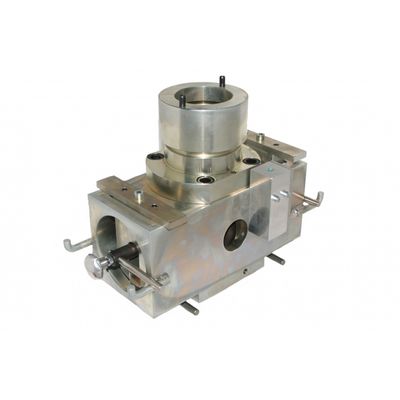
Gouda-Geo - Push-and-Pull Clamp for Electrical CPT
The CPT push-and-pull clamp is purposely designed for automatic pushing and pulling of CPT sounding tubes (Ø = 36 mm) and casing tubes (Ø = 55 mm) during electrical CPT testing operations.
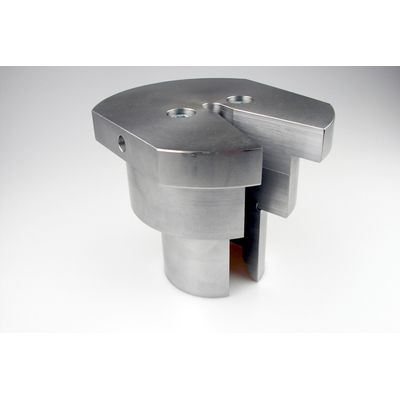
Gouda-Geo - Push Head
The push head is a simple device used for pushing a string of CPT sounding tubes and an electric CPT cone / piezocone into the ground. The push head is equipped with an integrated proximity switch, that gives the enabling signal to the data acquisition system the moment the Cone Penetration Testing procedure starts. The push head is mounted in a slide rail under the push-and-pull yoke of the penetrometer pusher. It has a special cable guide for the unobstructed passing of the CPT sounding cable which protrudes through the string of CPT sounding tubes. The push head itself is connected to data acquisition system by means of a spiral cable.
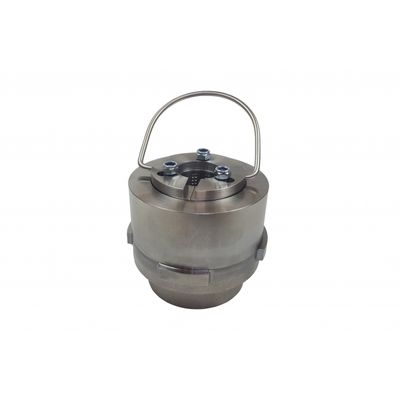
Gouda-Geo - 36 mm CPT Pulling Clamp
When doing mechanical CPT tests, the CPT sounding tubes are pushed into the soil by means of a mechanical or electrical measuring head. At the end of each test traditionally the tubes are pulled up by means of either a pulling kit (pulling bowl with pulling piece) or a ball clamp. The largest disadvantage of the pulling kit is the fact that working with it is quite laborious. A ball clamp is quicker perhaps, but it jams quite rapidly (and does not come loose unless brutal force is applied) and damages the tubes.