


ISS, Inc. products
Fluorescence - ISS for Fluorescence Applications - Instruments for Fluorescence Applications
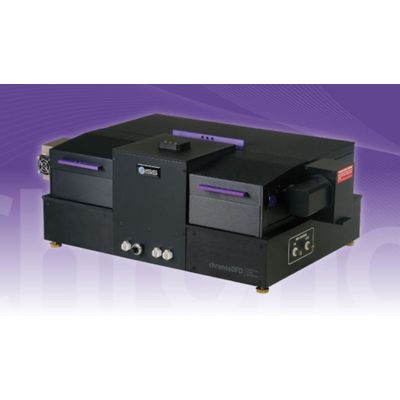
Model ChronosDFD - Digital Frequency Domain Spectrofluorometer
ChronosDFD for lifetime measurements in complex decays in less than 1 second. ChronosDFD is fully-automated through Vinci, a user-friendly, Windows-based software package.
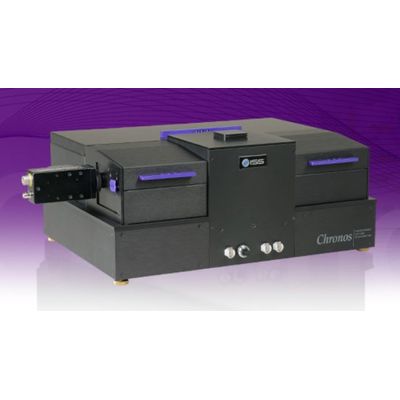
Model ChronosBH - Time-Domain Fluorometer
ChronosBH is a time-domain fluorometer with picosecond resolution. Its optical design and automatic instrument control are state-of-the-art for time-resolved fluorometers. ChronosBH is fully-automated through Vinci, a user-friendly, Windows-based software package.
Fluorescence - ISS for Fluorescence Applications - Components from ISS
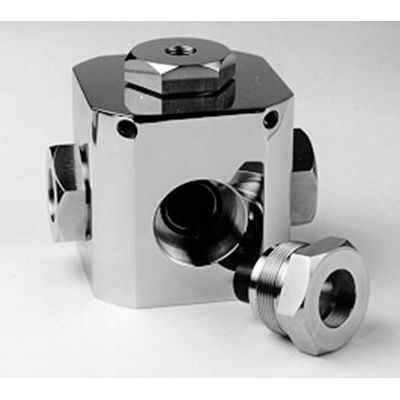
High-Pressure Cell System
The ISS High Pressure Cell System (HP Cell) has been designed for Absorption, Fluorescence, Raman spectroscopy and polarimetry studies of solid and liquid samples. The cell, built in a stainless-steel alloy, reaches pressures up to 400 MPa (4,000 bar) using a hydrostatic pump. The HP Cell can be mounted directly into ISS spectrofluorometers and several commercial instruments; also, it can be used as a stand-alone unit. The HP Cell comes either in a 3- or 4-windows version; the windows are located at 90 degrees from each other. Quartz and sapphire windows feature a 10mm aperture; MgF2 windows (used for polarimetry studies) feature a 3mm aperture. The high aperture 10mm-diameter windows allow for using as an excitation light source either a laser, a light emitting diode (LED) or a collimated beam from a xenon arc lamp. The unusually high numerical aperture (NA = 0.18) for a cell makes it unique for high sensitivity fluorescence studies.
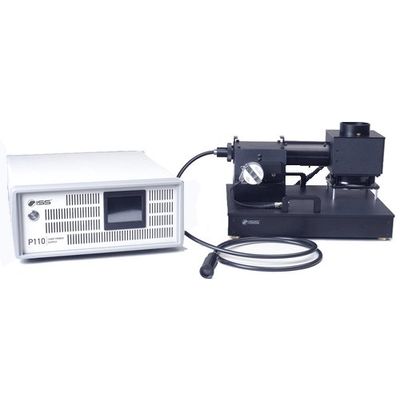
IlluminatorIlluminator
The illuminator is a convenient source of radiation in the wavelength range from 230 nm to 850 nm. The light is generated by a xenon arc lamp and the wavelength is selected by a single-grating monochromator with a grating blazed in the UV. At the exit of the monochromator the light is collected by a 180mm-long fiber bundle covering the rectangular shape of the slit to maximize the light collection. The delivery end features a round aperture; a telescopic lens is positioned at the exit of the fiber for allowing the control of the parallelism and size of the illumination beam. The components are conveniently mounted on a baseplate for easy positioning and transportation in the laboratory space. The wavelength is selected by manually moving the rotating dial on the monochromator. Alternatively, the monochromator can be controlled through the computer by using a Motor Controller unit and the Vinci software; the wavelength can then be selected through the computer.
Microscopy - Choose Alba, Q2 and PL1 for Microscopy Applications
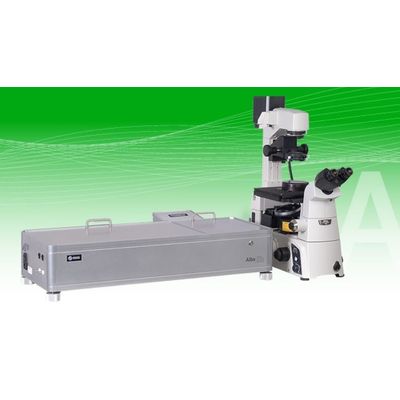
Alba STED - FLIM/FFS Laser Scanning Nanoscope
The instrument for quantitative cell biology at single-molecule detection. Stimulated Emission Depletion (STED) is a powerful microscopy technique that allows for the observation of fluorescence structure with spatial resolution below the diffraction limit. The Alba-STED uses the pulsed excitation and pulsed depletion approach (pSTED) in combination with the digital frequency domain fluorescence lifetime imaging (FastFLIM) to record the time-resolved photons which allows for an increase in the image resolution and the separation of two labels with the same excitation wavelength.