


- Home
- Companies
- Qubit Systems Inc.
- Products
- Animal Insect Aquatic Human - Respirometry - Human
- Animal Insect Aquatic Human - Respirometry - Animal
- Animal Insect Aquatic Human - Respirometry - Insect
- PlantScreen Modular Systems
- Animal, Insect, Aquatic, Human - Aquatic Biology- Aquatic Control
- Animal, Insect, Aquatic, Human - Aquatic Biology- Aquatic Respiration
- Plant Photosynthesis
Qubit Systems Inc. products
PlantScreen Modular Systems

RGB Structural Imaging
A central feature of any phenomics screening system is the ability to track growth patterns of plants as they progress through developmental stages and/or through the imposition, onset and recovery from stresses. All PlantScreenTM systems incorporate imaging stations for morphometric analysis of plants, as well as colour analysis. Morphometric and colour analysis may be conducted with equal effectiveness on monocotyledenous and dicotyledonous plants. Scanning is rapid for high throughput analysis, and automated protocols in software correct for any image distortions and provide accurate data of key morphomteric parameters chosen by the operator. The data are collated with data from other imaging stations, if employed, to correlate changes in growth patterns with physiological responses to imposed environmental conditions.
Model Chlorophyll - Plant Chlorophyll Fluorescence Imaging
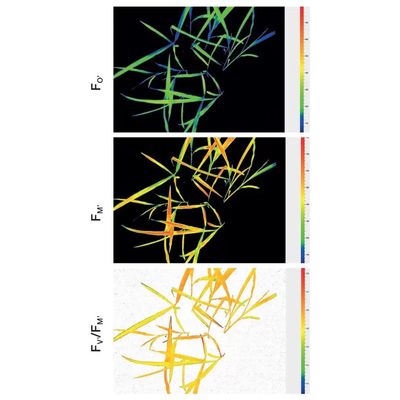
Qubit Systems, in collaboration with our European partners Photon Systems, were the first to develop a commercial system for imaging chlorophyll fluorescence kinetics. Chlorophyll fluorescence is an extremely valuable technique in plant physiology used for rapid noninvasive measurements of photosystem II activity. PSII is very sensitive to numerous biotic and abiotic factors so that chlorophyll fluorescence may be used as a rapid indicator of photosynthetic performance in response to changing environmental conditions, and during different developmental stages of the plant. The FluorCam imaging systems monitors fluorescence kinetics using a pulse amplitude modulated method PAM, which allows for all major fluorescence parameters (not just Fv/Fm) to be measured and imaged.