

Bollegraaf Group
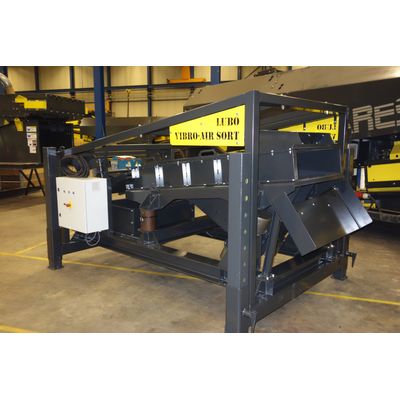
Lubo - Model Vibro-Air-Sort -Air Waste Sorting System
FromBollegraaf Group
The Lubo Vibro-Air Sort is a smart and compact solution for the separation of materials with different specific gravity. For example, the Vibro-Air Sort is particularly suited to the removal of polystyrene contamination from sieve sand, or for applications in glass recycling for the removal of contamination by paper and films. Processing capacity is dependent upon the fraction to be separated, but is typically up to 6 tonnes per hour.
Most popular related searches
sorting system
waste sorting system
vibrating conveyor
blasting nozzle
well integrity
glass industry
demolition waste
glass recycling
waste sorting
ore sorting
- The system consists of a vibrating conveyor, of which the angle is adjustable, linked to a blast nozzle with variable setting.
- 2 vibration motors ensure the stable and reliable operation of the vibrating conveyor.
- Also due to the adjustable in-feed, there is a wide range of applications for the separation of contaminated fractions.
- The compact construction ensures that the Vibro-Air Sort can be well-integrated into a new or existing sorting line.
- Fine sieve sand often contains unwanted contamination by insulation material which is released during demolition works.
- To upgrade this sieve sand in quality it must be purged of the contaminating light particles.
Benefits of the Vibro-Air Sort in comparison with standard large windshifters are:
- Due to the compact construction of the Vibro-Air Sort, the system can be swiftly and easily incorporated in both existing and new sorting lines.
- The low energy consumption of 7.8kW ensures that energy costs remain very favourable in comparison with the added value of the end product.
- The Vibro-Air Sort is very versatile. In addition to the purging of sieve sand (construction and demolition waste), the installation is also particularly suitable for use in the composting and glass industries.
- The system’s variable settings ensure that the fraction which is fed in is separated properly, even in the event of a change in the composition of the material.
- Low investment outlay.