


BRAVE Analytics
  1. Companies
  2. BRAVE Analytics
  3. Products
  4. BRAVE - Model OF2i + Raman - Analysis ...
BRAVEModel OF2i + Raman -Analysis for Particle Characterization

SHARE
BRAVE Analytics has developed a cutting-edge method for particle characterization by combining OptoFluidic Force Induction (OF2i) and Raman spectroscopy, inspired by Arthur Ashkin's optical tweezers. The technique uses light's ability to manipulate and trap particles, facilitating the measurement of particle size, concentration, and chemical composition in a continuous flow system. The BRAVE B-Elementary module features an innovative setup that slows down or stops particles momentarily to read their Raman spectra, achieving high-throughput analysis of up to 60 particles per minute. This user-friendly system requires minimal sample preparation and can process a wide range of particle sizes from approximately 500 nm to 5 µm. It can be enriched by integrating inductively coupled plasma-time-of-flight mass spectrometry (ICP-ToF-MS) for complementary analysis, delivering highly sensitive measurements even at ultra-low particle concentrations. Potential applications span from nanotoxicology and quality control in pharmaceuticals to environmental science, enabling detailed, accurate particle characterization.
Most popular related searches

First came the OptoFluidic Force (OF2i®) method, inspired by Arthur Ashkin’s optical tweezers. As a unique way of measuring the size and concentration of particles continuously, OF2i® raised the bar on online (nano)particle characterization, providing single-particle accuracy and insights into complex polydisperse systems. After the launch of the first OF2i® benchtop instrument, BRAVE B-Curious, the BRAVE team began working on additional particle analytics modules – and the idea for a Raman module, BRAVE B-Elementary, was born. Read on to learn how this optical trapping technique coupled with flow-through Raman spectroscopy will revolutionize the way you analyze particles.


Is it possible to adapt the fundamentals of optical tweezers to hold particles in flow steady enough to read out their Raman spectra?  The answer is Yes. Using our knowledge of optical trapping (OF2i®), we created a laser setup which either slows down or stops particles for a short time as they flow through the measuring cell. The resulting Raman analyzer works in-flow and identifies up to 60 particles per minute via their Raman spectra – with automated sample handling and almost no sample preparation.

How does combined OF2i®-Raman work?

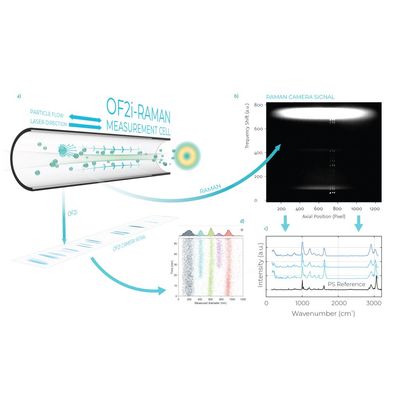
Let’s look at the schematic of the OF2i®-Raman setup, here showing measurement of 5 µm polystyrene (PS) beads.
(a) Fluidic forces transport the particles through the cell; a focused laser beam optically manipulates the particles.
(b) A SCMOS camera records the scattered Raman signal of individual particles at up to 30 frames per second. The camera image shows the recorded light of three 5 µm polystyrene beads. (see Reference 1)
(c) The analysis of the camera signal (Raman spectra) is compared with a reference spectrum. (see Reference 1)
(d) The OF2i® signal uses the speed of each particle to calculate particle size. (see Reference 2)


In a proof of concept (see Reference 2) for the combined OF2i®-Raman measurement, titanium dioxide particles (P1, P2) were trapped and the phases analyzed to distinguish between rutile and anatase.