


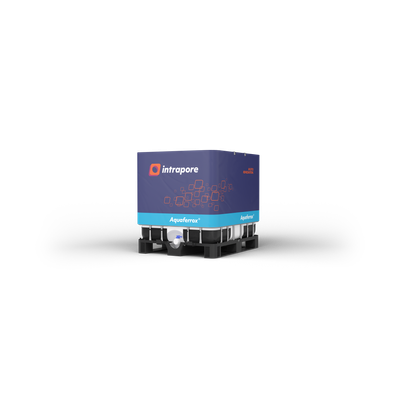
Aquaferrox - Colloidally Stabilized Iron Oxide for Contaminant Immobilization
Iron oxides are naturally occurring minerals that form in soils and sediments from the weathering products of Fe-bearing minerals. They have a high specific surface area and a characteristic red/orange color. Iron oxides act as key reactive components in soils and are also responsible for the typical brown coloration of our soils. In industry, iron oxides are used in particular as pigments and as adsorber materials for the immobilization of contaminants.
Aquaferrox® consists of specially prepared goethite particles which – stabilized in colloidal form – are injected into the subsoil. After controlled dispersion, they are immobilized on the aquifer matrix, thus forming an in situ adsorption barrier through which groundwater flows. Due to the high affinity of Aquaferrox® for heavy metals and semi-metals (e.g. As), these contaminants can be immobilized on site without resorting to energy- and cost-intensive measures such as pump-and-treat, excavation or soil washing.
- Enables the sustained immobilization of dissolved heavy metal and metalloid ions/complexes in groundwater by adsorption.
- Enables a long-lasting immobilization effect due to the high adsorption capacity and thermodynamic stability of the goethite particles,
- Is ecotoxicologically safe.
- Can be injected with standard direct-push systems.
Through a special treatment of conventional iron oxides, the iron oxide aggregates in Aquaferrox® are colloidally stabilized and achieve higher adsorption capacities than untreated or conventionally ground iron oxides. Accordingly, at concentrations of 1 mg As L-1 in groundwater, about twice the As loadings to Aquaferrox® can be expected compared to counterparts without this special treatment.
Iron oxides predominantly exhibit their point of zero charge (isoelectric point, IEP) between 7 ≤ pH ≤ 8, i.e., at pH < IEP they exhibit a net-positive charge and at pH > IEP a net-negative surface charge. Thus, adsorption of anions (e.g., dissolved As complexes in groundwater) is electrostatically favored at pH < IEP, while at pH > IEP As adsorption is less effective. This pH dependence of adsorption plays a minor role with Aquaferrox®. Due to the special treatment, the surfaces of the iron oxide particles in Aquaferrox® have a net-negative charge (higher number of negatively charged vs. positively charged surface sites; UE = -38 ± 3 mV in Table 1) even at comparatively low pH values (pH < 7). Despite this net-negative charge on the surfaces of the iron oxide particles in Aquaferrox®, higher adsorption intensities were nevertheless obtained compared to the iron oxides without special treatment but net-positive surface charge (pH = 5.7, i.e. pH < IEP; Figure 1). Temporary fluctuations in groundwater pH to values >7-8 are therefore, in contrast to the conventional iron oxides, less critical with regard to the adsorption performance of anions such as dissolved As species in the groundwater.