

- Home
- Companies
- AWAS International GmbH
- Products
- AWAS - OLOID Stirring Technology
AWAS - OLOID Stirring Technology
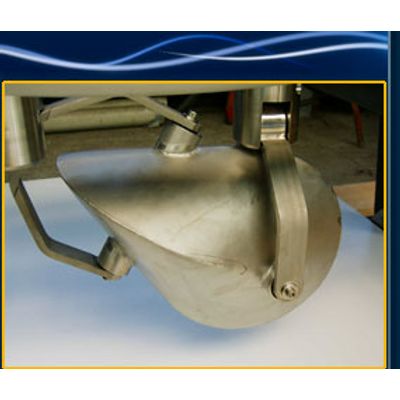
Due to its special shape, the OLOID is not a stirring body in the traditional sense. In contrast to propellers, where the material to be stirred is set in motion by rotation, OLOIDs convey the material to be stirred from the depths using rhythmic impulses and pass it on at right angles. This results in a more complete circulation of the material to be stirred.
The OLOID was discovered by the Swiss mathematician and inventor Paul Schatz, who derived the shape and function of the tail fins of fish, particularly trout. With this so-called inversion kinematics, it is possible to achieve excellent performance even at low speeds.
The use of OLOID stirrers and aerators offers a number of advantages, including:
- Can be used as a surface aerator or deep agitator.
- Exceptional circulation and ventilation performance with low power consumption
- Careful handling of the material to be stirred
- Low maintenance, OLOIDs are self-cleaning
- Flexible adaptation to fluctuating water levels
- Reduction of excessive algae growth and duckweed formation
Where are OLOID stirrers and aerators used?
The OLOID technology is already used in various areas of wastewater treatment. In addition, new applications are constantly being developed:
- pond treatment plants
- municipal sewage treatment plants
- leachate treatment
- treatment of industrial wastewater
- horticulture
- Renaturation of eutrophic ponds and lakes
- other possible uses
models
- OLOID Type 200
- OLOID Type 400
- OLOID Type 600
versions:
- Type 200/400 A: for operation as a surface stirrer
- Type 600 O: for operation as a surface stirrer
- Type 200/400/600 T: for operation as a deep mixer
- Type 200/400 A/S: for operation in salt water
- Type 200/400 B:for solar operation
Advantages of OLOID technology in pond treatment plants:
- Elimination of dead spaces with oxygen deficiency, thereby better degradation of the contaminant load and higher efficiency of the system.
- Reducing energy consumption by replacing/supplementing existing ventilation systems.
- Improved oxygen uptake through wave formation and the associated increase in the water surface.
- Preventing duckweed growth.
- The float design allows for flexible adaptation to fluctuating water levels and easy positioning throughout the system.
- By simply adjusting the immersion depth, operation as a stirrer or as an aerator is possible.
- Self-sufficient operation possible through the use of photovoltaic modules.
Advantages of OLOID technology in municipal sewage treatment plants:
- Low energy consumption, especially in small tanks where conventional stirrers use too much energy.
- Gentle circulation produces hardly any shear forces, activated sludge flocs are retained and the settling behavior is improved.
- Flexible adaptation to fluctuating water levels thanks to float design.
- Suitable for supplementing/improving the existing stirring system.