


- Home
- Companies
- Terra Systems, Inc. (TSI)
- Products
- Terra Systems TSI DC - Bioaugmentation ...
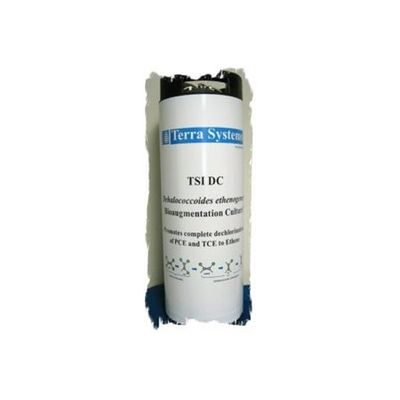
Terra Systems TSI DC - Bioaugmentation Culture
Terra Systems TSI DC Family of Bioaugmentation Cultures for In-Situ Bioremediation. Dehalococcoides mccartyi is primarily responsible for the complete dechlorination of PCE and TCE to ethene under anaerobic conditions. At sites where Dehalococcoides microorganisms are not present or are found at low numbers, the process will often “stall” at cis-1,2-dichloroethene. Terra Systems TSI-DC Bioaugmentation Culture, which contains greater than 1 x 10¹¹ Dehalococcoides/L is injected into the aquifer and will promote the complete dechlorination of PCE or TCE.
TSI-DC® Dehalococcoides mccartyi Bioaugmentation Culture® is an enriched natural bacteria culture that contains Dehalococcoides species for bioaugmentation. This culture dechlorinates tetrachloroethene (PCE) and trichloroethene (TCE) to the non-toxic product ethene. It also can biodegrade carbon tetrachloride and chloroform to methylene chloride and innocuous products. It can be used at sites where bacteria capable of complete reductive dechlorination are not present or there is a need to decrease the remediation time frame. It is estimated that Dehalococcoides are not present in 10 to 40 percent of chlorinated solvent contaminated sites.
Terra Systems 50/50 mix of TSI DC and TSI TCA Dehalococcoides mccartyi/Dehalobacter Bioaugmentation Cultures® is added to the groundwater at sites where the native microorganisms of Dehalococcoides and Dehalobacter are not present, not in sufficient quantity or when the client wants to decrease the remediation time frame for the biodegradation of chlorinated solvents such as tetrachloroethene (PCE), trichloroethene (TCE) and trichloroethane (TCA).
Terra Systems TSI DC RR Rodococus ruber Bioaugmentation Culture® is added to the groundwater at sites where the native microorganisms are not present, are not in sufficient quantity, where the native population does not express all of the required functional genes for 1,4-Dioxane reduction, or when the client wants to decrease the remediation time frame for the biodegradation of 1,4-Dioxane. The TSI DC RR culture is aerobic and requires propane as a cometabolic substrate.