

- Home
- Companies
- CECO Environmental
- Products
- CECO HEE-Duall - FRP Ventilation Fans ...
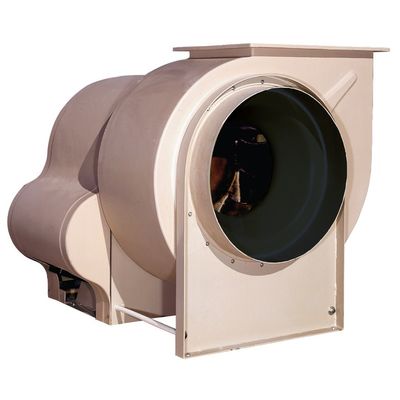
CECO HEE-Duall - FRP Ventilation Fans for Hazardous Airflow
Ventilation equipment used for applications containing potentially explosive gases in the airstream must be properly selected and specified by Engineers and Designers to provide a safe operating system. This data sheet will provide a basic understanding of industry standards and common solutions for these applications.
Explosion Proof Versus Spark Resistant
Devices such as electrical motors and other electrical enclosures are available with an explosion proof rating and must be able to contain any explosion originating within the motor or the enclosure and prevent sparks from reaching the surrounding area that could contain explosive vapors, gases, dust or fibers. Therefore, an explosion proof rating does not mean the device is able to withstand an exterior explosion. Instead, the motor or enclosure must prevent an internal spark or explosion from igniting vapors or gases in the air surrounding the fan.
While it is not possible to build an explosion proof rated fan, it is possible to design for spark resistant fan construction using specialized fabrication techniques and minimize the risk for igniting potentially explosive vapors or gases inside the fan airstream.
Industry Standard AMCA 99-16
Construction standards for air handling equipment processing potentially explosive or flammable gases have been developed by the Air Movement and Control Association International (AMCA). AMCA Standard 99-0401 provides a classification for Spark Resistant Fan Construction and defines three levels of spark resistant construction: Type A, B and C. However, this standard only applies to metal and nonmetal fans. The construction standards for fiberglass (FRP) or other plastic fans is not been addressed by AMCA 99-0401 Standard. Therefore, special construction is required for FRP fans with spark resistant construction.
Static Electricity
Fans fabricated from corrosion resistant materials such as fiber reinforced polymer composites (FRP) or other plastic materials provide an excellent degree of spark resistance since the fan components are made from non-metal components. This removes the possibility of two metal surfaces striking together to create a spark. However, under the right conditions FRP has the possibility of building up static electricity or an electrical charge. This electrical charge can be generated by gases or an airstream passing over the fiberglass surfaces and results in the transfer positive or negative electrons. Static electricity as the name implies, indicates electricity at rest and tends to remain localized. When the plastic material comes in contact with a body of a different electrical potential, an electrostatic discharge (ESD) occurs via an arc or spark. This arc or spark occurring inside the fan is dangerous when the airstream contains flammable vapors or gases.
AMCA 99-0401 Standard
TYPE A offers the highest degree of spark resistant construction but is also the highest cost solution using non-metal materials such as aluminum. The fan components are assembled to lower the possibility of contact between the rotating wheel and fixed fan components.
TYPE B requires a non-metal wheel and a fan design system that prevents the fan wheel, shaft and bearings from shifting. This cost falls between Type A and Type C.
TYPE C offers the lowest degree of spark resistant construction and is the most cost effective solution. The metal fan components are assembled to reduce the possibility of contact between the rotating wheel and fixed fan components.
Refer to AMCA 99-0401 Standard for further information and details.
Fiberglass is a nonconductor of static electricity and has the potential to retain or store static electricity just like a capacitor. Static electricity that can build up on the airstream surface of the fan components must be removed to control the potential for the fumes being ignited by a spark or arc. Fortunately, the surfaces of the fan components can be made electrically conductive using a specialized surface coating material. The proper application of an electrically conductive carbon on the fan components is accomplished by applying a proper mixture of resin and a black conductive carbon material on the final surfaces of all fan components exposed to the air stream. This mixture when properly applied forms a continuous electrical pathway to dissipate any static electricity to an external ground.
Contact connection points are embedded in the conductive surface layer of various fan parts and are connected with a copper grounding wire to a ground lug bolted to the steel fan frame. It is critical that the customer connect the ground lug on the fan base during installation to a true earth ground source. This final step effectively grounds the surface of the fan components to dissipate any static electricity to a ground source.
Fans supplied with a conductive carbon coating provide sufficient conductivity through the bearings and it is generally not necessary to provide brush-type contacts on the fan wheel and shaft assembly for most fans.
A surface resistivity reading of 1 megaohm (106 ohms) and lower is considered to be conductive according to the Electrostatic Discharge Association (ESD) and the Electronic Industrial Alliance (EIA) Standards. All FRP fans provided by HEE-Duall test well below this value and provides an electrical path to make the surface conductive and dissipate static electricity.
The addition of a conductive carbon material on the surface of the fan components will not affect the corrosion resistance properties of FRP since carbon is an inert filler material. However, the addition of carbon lowers the surface hardness and will result in lower Barcolhardness surface readings.
Fiberglass fans supplied by HEE-Duall are the best solution for applications handling corrosive airstreams. When the airstream contains potentially explosive vapors or gases, the application of a conductive carbon material as used by HEE-Duall is the best alternative. However, remember there are no guarantees against completely eliminating static electricity and the possibility of an ignition of an airstream.
The designer should use the utmost care in fan system design when moving airstreams contain potentially explosive vapors or gases. The designer is also responsible to identify the risks and to design a safe system for the application. The total system should be viewed from many different angles, in particular when component or fan failure could occur in areas where personnel are working or just passing by. Ongoing maintenance, inspections and cleaning are also part of maintaining a safe operating fan system. Other considerations for a safe operating fan system could include the use of an electrical motor and disconnect switch with the proper electrical rating. This will depend on the installation environment and the various classes and divisions of the explosive atmospheres surrounding the fan location.
Contact HEE-Duall Application Engineers who can assist you in selecting the proper fan equipment and offer construction features for your application.