


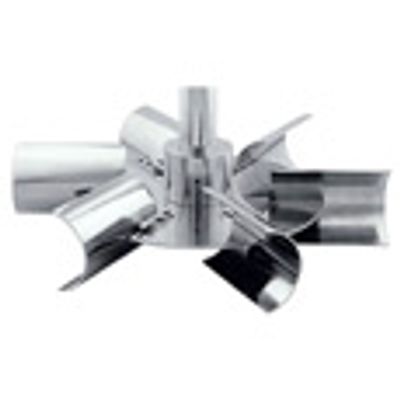
Chemineer - Model CD-6 -Concave Impeller Pump
The CD-6 impeller is a second generation gas and immiscible liquid dispersion impeller. The CD-6 can handle about 2.4 times the maximum gas capacity of the D-6 impeller. The CD-6 is similar to the Smith impeller, but there are substantial power and dispersion capability differences. This impeller has been used at aeration numbers as high as 2.1.
The CD-6 impeller improves the mass transfer rate as much as 50% in gas dispersion operations.
The CD-6 Impeller is revolutionizing the field of agitated gas dispersion. In applications of high energy agitation and high gas rates, This impeller will significantly improve The mass transfer factor. kLa. Given the same conditions of power per volume and superficial gas velocity, mass transfer factors can nearly double when the CD-6 impeller is used instead of the conventional flat-blade disc impeller.
In addition to significantly improving mass transfer factors, the CD-6 impeller will handle at least 46% more gas before flooding than the flat-blade disc impeller. This capability gives added benefit in operations where upsets could otherwise flood the flat-blade disc style impeller.
Most applications designed with the CD-6 impeller also use Chemineer`s HE-3 High-Efficiency Impellers (Request Bulletin 713). This configuration utilizes a combination of impellers; the bottom impeller is the CD-6 and the upper impellers, at times as many as four, are HE-3s.
The CD-6 accomplishes the primary dispersion while the HE-3 high-efficiency impeller provides good overall top-to-bottom flow and rapid blend times. In applications such as fermentation, this combination results in uniform dissolved oxygen distribution within the fermenter and shorter blend times for additives.
Impeller Development
The original concave blade concept was developed in the 1970s at Delft University by a group led by John M. Smith, now BOC professor of Process Engineering, University of Surrey, England. Independent testing has been done over the past decade by private research groups and the findings have confirmed that at the high end of gas flow rates and agitator energy density, the concave-blade disc impeller can show dramatic improvements in mass transfer factors over the standard flat-blade disc design.
The CD-6 impeller was developed by Chemineer as a result of our extensive study of this concept. Parameters
which affect power draw, pumping capacity, etc., were investigated thoroughly in addition to the mass
transfer characteristics. Testing was done using two different configurations: the CD-6 alone and combined with Chemineer`s HE-3 high-efficiency impeller in the upper positions. The testing was done in a clean water mass transfer testing facility in our laboratory. Data collection and analysis was facilitated by a computer-based data acquisition system.
Laboratory testing under fixed conditions, however, may not always be a true representation of actual operating conditions. We have verified our laboratory testing by many field-proven installations. Chemineer`s industrial experience includes dozens of installations utilizing the CD-6 impeller in gas dispersion operations, including applications to 1000 horsepower. These installations have confirmed power draws predicted during gassing and have demonstrated improved mass transfer rates by as much as 50% over the flat-blade disc impeller.
Process Performance
Fundam entally. the m ass transfer rate, normally expressed in engineering terms, is the product of the mass transfer coefficient, the interfacial area per unit vdume of liquid and the mean gas concentration deficit.
The degree of mass Transfer is directly proportional to the mass transfer factor, kLa. Thus, all other things being equal, a doubling of the mass transfer factor will result in a doubling of the rate of mass transfer.
It is this mass transfer factor which, under the same conditions of power per unit volume and superficial gas velocity, can nearly double when using the CD-6 impeller.
The CD-6 impeller also improves kLa by pumping more liquid under gassing conditions. There are two processes in gas dispersion which continually oppose each other: dispersion and coalescence. These two opposing rate processes have dramatic effects on the mass Transfer factor. kLa. The CD-6 impeller minimizes the tendency for coalescence b decreasing the probability of bubbles existing in the same incremental flow volume.
Since the CD-6 impeller pumps more liquid, the probability of two bubbles coalescing is reduced. As the gas rate is increased, the advantages of using the CD-6 also increase. Typical performance curves comparing the ratio of kLa for a CD-6 impeller to a flat-blade disc (D-6) impeller are shown in the graph as a function of horsepower per one thousand gallons and superficial gas velocity.
The improvement or "enhancement" increases markedly for power levels of 15 to 20 horsepower per 1000 gallons and superficial gas velocities of 0.2 to 0.3 ft/sec.
CD-6 Impeller Features
The CD-6 impeller is available in a standard configuration of six concave blades offered in three construction styles: (1) All Welded. (2) Bolted and (3) Bolted-Adjustable.
The bolted-adjustable style permits impeller diameter adjustments of ± 6%, which translates to a ± 25% invested power variation. The adjustable construction style enables the customization of the impeller diameter to achieve maximum performance for the process. It is of particular benefit when processes are undergoing subtle changes or are not fully defined.
Impeller sizes ranging from 18 to 72 inches in diameter are readily available. Designs requiring smaller or larger impellers can be built to your specific application. The usual materials of construction are carbon steel or 316 stainless steel. Fabrications from special alloys and L-grade stainless steel are also available.
For a complete review of your specific gas dispersion requirements, whether it is to retrofit existing agitation equipment to improve performance or a new installation, please contact your Chemineer representative. He can determine the most efficient agitator design for your process.