


- Home
- Companies
- Noardling B.V.
- Products
- Noardling Landustrie - Clarifier
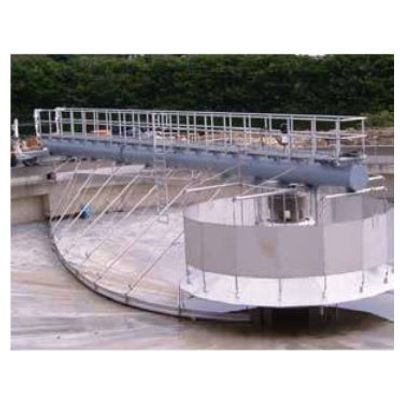
Noardling Landustrie - Clarifier
A clarifier, also called scraper bridge, is a mechanical construction that is an important part of a water treatment plant. Sedimentation basins or settling tanks can be provided with a clarifier or scraper bridge. The purpose of this installation for clearing sediment into a sludge tank and to remove all floating substances.
We design high quality aluminium clarifiers to accommodate the most challenging influent profiles and treatment standards. Our clarifiers are adapted to your project specification, based on standard components.
In addition, they meet common standards set by prescribing authorities.
The clarifier can be supplied with either a peripheral drive system or a central drive unit. Commonly used materials are a combination of aluminium (above water) and stainless steel.
Peripheral drive clarifier
Our clarifiers come standard with a two-wheeled arrier. One wheel is directly driven by a motor reduction gear. In the centre of the tank, the bridge is supported by a ball thurst bearing. Various types of bridge beams can be provided:
- Tubular beam
- Plate beam
- Profile beam
- Trapezium beam (aluminium)
These beams can be supplied as follows:
- Half bridge: the peripheral side is fitted with a two- wheeled carrier
- Two/third bridge: the peripheral side is fitted with a two-wheeled carrier
Central drive clarifier
For tanks with a diameter up to 50 m, a central drive system can be used. The drive features a special drive unit fitted to the shaft or cage which can be equipped with an overload sensor. The scraper arms are fitted with blades and are connected to the drive unit by means of a shaft or cage.
- Feedwell (inlet drum)
- Obstacle and/or slip protection
- Weirs and baffles, defl ection plate
Unlike other designs, our scraper system does not rest on wheels over the tank bottom. There is no contact with the bottom (with the exception of the rubber strip), wear to the bottom of the tank is not an issue and risks of malfunction during operation are minimized.