


- Home
- Companies
- Dam-It Dams, Inc.
- Products
- Dam-It Dams - Portable Cofferdams
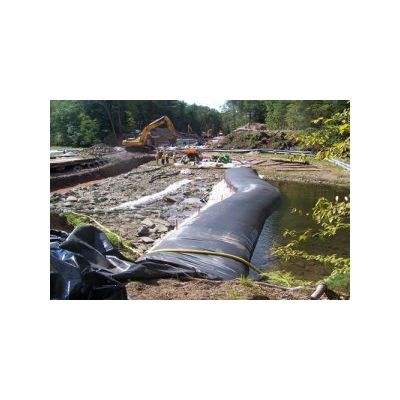
Dam-It Dams - Portable Cofferdams
Cofferdams (also coffer dams) are a temporary enclosure in or around a body of water that is constructed to allow dewatering, diversion or damming of an enclosed area. The primary purpose of cofferdams are to create a dry environment for a project to proceed. They were first used in 1736.
Today’s coffer dams are typically conventional embankment dams of both earth- and rock-fill, although concrete or some sheet piling also may be used.
There is a company headquartered in Michigan – Dam-It Dams, Inc. – whose dams use on-site water to fill dual inner tubes that cause the dam’s chambers to slowly and evenly inflate, forming a strong, stable cylindrical tube. As the inner tubes continue to fill and the water pressure builds, the dam unrolls in a controlled manner to create cofferdams.
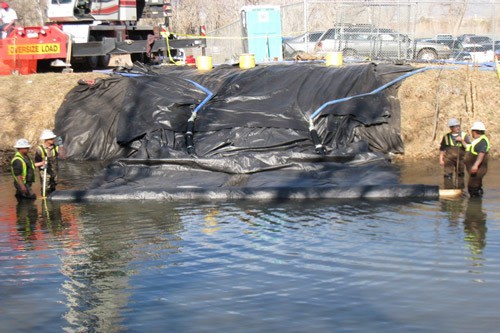
There are as many water-control applications as there are types of cofferdam. Dam-It Dams’ patented, portable, water-filled Cofferdams offer effective and cost-efficient solutions for these major types of situations that are called the 3-Ds of water control:
Dewatering:
Dewatering, unwatering and water control are common terms used to describe the removal or drainage of ground or surface water, typically on a construction site. Dewatering is often required before subsurface excavation for such things as foundations, shoring, cellar space and repairs to existing water structures.
Diversion:
Diversion is the temporary (or sometimes permanent) re-routing of water. It may be required to initiate a project and/or allow a project to proceed.
Damming:
Damming is the process of creating a barrier that holds back water. The barrier may be needed to maintain water table levels, collect water for storage and prevent water from crossing established/safety thresholds.
Because Dam-It Dams’ Cofferdams work with Mother Nature, not against her, they create effective water barriers that leave no – or only a minimal – footprint on the environment. And, their Cofferdams are industrial strength and reusable to minimize additional investment costs.
What to Look for in a Contractor
Selecting a contractor (or contractors) to manufacture and install a cofferdam to meet your specific needs is one of the most important decisions you will make to ensure the success of the project.
There are several factors to be considered:
Number of Contractors
- One contractor for manufacture and installation?
- One contractor for manufacture; another contractor for installation?
- One contractor for manufacture; self installation?
- One contractor for manufacture; self installation with contractor supervision?
Cofferdams Size
- Does the contractor offer coffer dams in the size(s) you need?
- Can the dams be manufactured and delivered to meet project timing?
- Are the dams water filled?
Equipment Needs
Who will provide the following equipment that is recommended for large cofferdam installations?
- At least two portable 2″-3″ water discharge pumps. Using more pumps will lessen fill time. The inner fill tubes will accommodate any size discharge hose,
- A discharge/suction hose for each pump
- Duct tape to secure and constrict the fill tubes
- Restraining ropes
(In moving water, restraining ropes should be used to help control the dams during installation. Every 100 feet of cofferdam require 250 feet of 1/2-inch rope. The use of four ropes is highly recommended for the installation of cofferdams that are six feet or higher in rapidly flowing water.)