


- Home
- Companies
- Falmouth Scientific, Inc. (FSI)
- Products
- FSI - Model HMS-622 CHIRPceiver - Dual ...
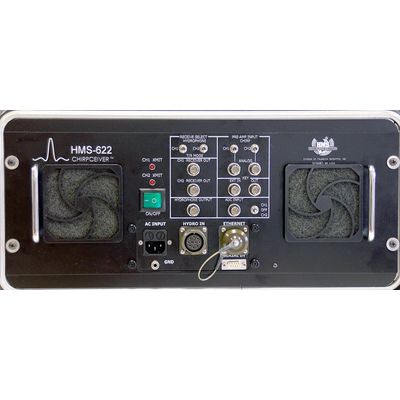
FSI - Model HMS-622 CHIRPceiver -Dual or Single Frequency Sub-Bottom Profilers
Sub-bottom profiling applications in diverse sediments require multiple frequency bands to support a wide variety of survey requirements. The HMS-622 CHIRPceiverTM and its Family of Transducer Arrays and Vehicles can fill this wide range of survey needs. The frequency bands supported by the HMS-622 include standard LF (1KHz- 10KHz), and optional ULF (200Hz-2KHz) and HF (8KHz- 23KHz). It can be easily configured for up to 50 KHz with a standard 2 channel transceiver. CW frequencies can also be programmed within the respective band. The transducer and hydrophone arrays are configured to perform both the transmit and the receive functions of the system.
The CHIRPceiver uses a flexible Graphical User Interface connected via Ethernet that allows the user to set CHIRP or CW modes of operation, Start & Stop frequencies, and Pulse Lengths & Power Level for the output pulses. The receiver controls allow for Gain and Attenuation as well as for Diagnostic modes. The user selectable direct A/D input enables input of data from the HMS-620 Bubble GunTM or another analog seismic system. The CHIRPceiver will also support multi-ping modes for higher along-track resolution when operating in water depths deeper than a given ping rate. All sonar data is logged in SEGY format using industry standard acquisition software.
- CHIRP acoustic pulses provide sub-bottom penetration through many sediment types
- Industry Standard Ethernet Interface for Data and Control
- Universal input power supply operates from 85 to 240 VAC
- Dual-Channel True 24-bit A/D Range
- 4 KW per Channel Output Power
- Flexible transducer array options for a variety of vessel configurations & survey needs
- Standard LF band (1KHz-10KHz)
- Optional HF (8KHz-23KHz)
- Optional ULF (200Hz-2KHz)
- Direct A/D Input available for Analog Seismic Systems like the FSI Bubble GunTM
- Industry Standard Data Format
HMS-622 CHIRPceiver System & Available Transducers
LF - Low Frequency Channel (standard)
- Transmitter and transducer: Array sizes from 1 to 4 Low Frequency 3.5 KHz Transducers for Towed and Over the Side Systems, and 4 to 35 for Hull Mounted Systems
- Power output:
- 2.3 KW, 15% duty cycle at 3.5 KHz for
- 212 dB re 1 μPa @ 1 m nominal,
- 4 KW maximum
- Frequency range: Sweeps in the 1KHz to 10KHz band
- Transducer radiation: 45° Conical (for a 2x2 4-element array)
ULF - Ultra Low Frequency Channel (optional)
- Transmitter and transducer: One AT-650 Transducer
- Power output:
- 2.3 KW, 15% duty cycle at 650Hz for
- 204 dB re 1 μPa @ 1 m nominal,
- 4 KW maximum
- Frequency range: Sweeps in the 200Hz to 2KHz band
- Transducer radiation: Omni
HF - High Frequency Channel (optional)
- Transmitter transducer: One 7-element high frequency transducer
- Power output:
- 1 KW, 15% duty cycle at 15 KHz for
- 214 dB re 1 μPa @ 1 m nominal,
- 4 KW maximum
- Frequency range: Sweeps in the 8KHz to 23KHz band
- Transducer radiation: 27° Conical
- Control: Software control through system Ethernet port
- Trigger: Internal or External
- Frequency: ULF (200Hz-2KHz), LF (1KHz-10KHz), HF (8KHz-23KHz) CHIRP and CW
- Pulse Length: User Programmable for CHIRP (5-100ms) and CW modes (15% duty cycle)
- Transmit Power: 0 to -21 dB in 3 dB minimum increments
- Preamplifier gain: 42 dB in 3 dB increments
- Preamplifier attenuation: -42 dB in 3 dB increments
- A/D Input:24bit up to 192KHz
* Specifications Subject to Change Without Notice