


- Home
- Companies
- Kore Technology Limited
- Products
- Kore - Model MS-200 - Electron ...
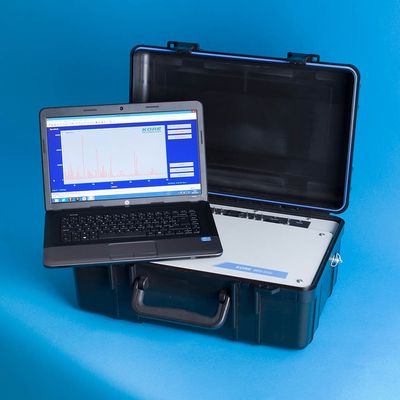
Kore - Model MS-200 -Electron Ionisation Mass Spectrometer
Kore is excited to present the MS-200: a portable, battery-powered electron ionisation mass spectrometer for gas analysis – entirely contained in a suitcase. The MS-200 transports the advantages of mass spectrometry – good specificity for the identification of unknowns, versatility, accuracy and sensitivity – from the laboratory into the field. The MS-200’s membrane inlet concentrator allows a wide range of gases to be identified and measured from the low ppb range up to percent levels.
Electron ionisation (EI) is one of the first and most widely used ionisation techniques in mass spectrometry and has been in use for over 100 years. The ionisation of analyte molecule relies on a beam of (usually) 70eV electrons removing an electron from the molecule during the collision. EI is described as hard ionisation; the excess energy in the collision produces many fragment ions. The ‘fingerprints’ or patterns of molecular and fragment ions can be related to extensive databases such as NIST and allow for mass spectral deconvolution. EI ionisation is most commonly used for ionisation of VOCs and SVOCs.
MASS SPECTROMETER
At the heart of the MS-200 is Kore’s patented Converging Annular Time-of-flight mass spectrometer. The CAT’s high sensitivity is the key to making the system portable. As extremely small quantities of sample gas are required, low powered, zero maintenance vacuum pumps can be used. The MS-200 uses electron impact ionisation, yielding spectra that correspond to extensive and well-established mass spectral databases. Unlike other mass spectrometers, the CAT’s very clean ion source eliminates problems associated with build-up of sample residues and electron emitting filament poisoning, giving enhanced filament lifetime with a consistent quantitative performance.
VACUUM SYSTEM
There is no need for a separate vacuum base station as the CAT vacuum system is kept permanently sealed and is entirely self-contained within the MS-200 case. The vacuum is maintained by an ion pump and a non-evaporable getter pump. The battery can run the ion pump for approximately four days. A mains adapter is used if the unit is to be left for many days. If the battery runs flat, the getter pump maintains the vacuum until power is re-applied.
INLET SYSTEM
Sample gases are drawn through a heated inlet system by a pump and enter the CAT source via a membrane assembly. The membrane assembly provides a long-life, low maintenance, rugged, concentrating sample inlet that allows ppb sample detection limits to be achieved for many compounds. Typical analysis times are under one minute even at the highest sensitivities and the membrane inlet yields a good quantitative accuracy.
DATA SYSTEM
Data is displayed on a notebook PC, using the Windows® based GRAMS/AI™ software from Thermo Scientific. This industry standard software has been customised by Kore to make the collection of spectra a simple press of a virtual button. Kore provides a spectrum library with library search facilities and data analysis software for the automatic analysis of mixtures that presents the identified sample gas components concentrations in tabular form.
- Concentration range: From ppb levels to 100% (% using minor isotopes)
- Maximum sensitivity: Benzene detection limit <5ppb in 10 seconds (membrane inlet)
- Mass resolution: >200 m/δm (FWHM)
- Mass range: 1-1000 m/z
- Electron impact ion source: 70eV; compatible with NIST database
- Dimensions: 531 x 328 x 213 mm
- Weight: 23kg
- Pumping: Built in ion pump
- Battery run time: Analysis: 6 hours (1 spectrum every 5 mins)
- Pumping only: 4 days
- Supplied with dual membrane inlet: Enhanced sensitivity for VOC detection
- Response time after new gas sample introduction: Variable, depending upon compound permeation rate. Typically tens of seconds.
APPLICATION AREAS
- Detection and analysis of volatile and semi-volatile organic contaminants (VOCs) on remediation sites – as a fast and cost effective screening process prior to site renewal
- Urban air quality research – measuring the spatial distribution of pollutants
- Industrial hygiene – including the quality analysis of air cleaning systems
- Emergency response testing – fast unambiguous identification of unknowns
- Fire and crime scene investigations – identifying accelerants used in arson at the fire scene.
APPLICATION NOTES