

- Home
- Companies
- ABM Sensor Technology
- Products
- ABM - Model R-EXP - Explosion-Proof ...
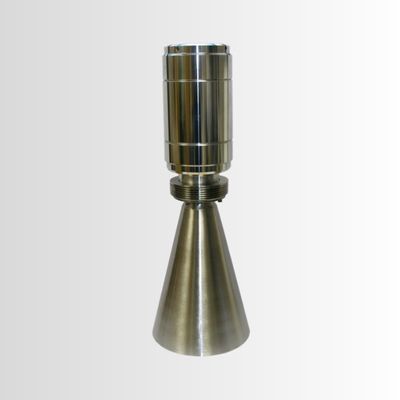
ABM - Model R-EXP -Explosion-Proof Radar Level Sensor
The R-EXP pulse radar sensor from ABM is the ideal solution for liquid, slurry or solid level applications in areas classified as hazardous (Class I Div I). The sensor is suited for processes with vapours, gases (CO2, CO, H2S, H2), foaming, ice or volatile surfaces. The non-contact radar sensor provides continuous level measurement up to 240 ft (73 m) with 4-20 mA output standard and simple push-button calibration.The R-EXP pulse radar level sensor is the ideal solution for liquid, slurry or solid level applications in areas classified as hazardous (Class I Div I). The radar sensor is suited for challenging environments with vapours, gases, foaming, ice or volatile surfaces.
- Explosion Proof (Class I Div I)
- Measuring range up to 240 ft (73 m)
- Non-contact continuous level measurement
- Self-cleaning, maintenance free operation
- Plug-and-play installation with simple calibration
- Remote monitoring and virtual support with optional Cellular Gateway
Learn more about the R-EXP radar level sensor here.
Industries
- Water & Wastewater
- Chemical
- Petrochemical
- Food & Beverage
Applications
- Process tank level and control
- Chemical inventory level in storage tanks
- Wastewater level in settlement tanks
- Influent wastewater monitoring
- Lift station pump control
- Open channel flow measurement
- Manhole sewer level monitoring
Radar level sensors are the ideal solution for level measurement of liquids and solids when dealing with challenging environments such as vapour, temperature variations, extreme temperatures, extreme dust, wind, foam, ice or acoustic noise.
ABM offers various radar level sensors to match your application. Our radar sensors are a one echo sensor. The sensors automatically adjust their transmitted energy and receiver sensitivity to get the same amplitude of wanted echoes regardless of the distance to radar, which allows a very narrow radiation beam and very short blanking. This technique allows the receiver to detect only one echo from the measured media while all false echoes are pushed under the noise level and eliminated.
Learn more about our non-contact radar level sensors here.