
- Home
- Companies
- Foshan Yixiang Materials and Resources ...
- Products
- KC-Panels - Fiberglass Honeycomb Panels
KC-Panels - Fiberglass Honeycomb Panels
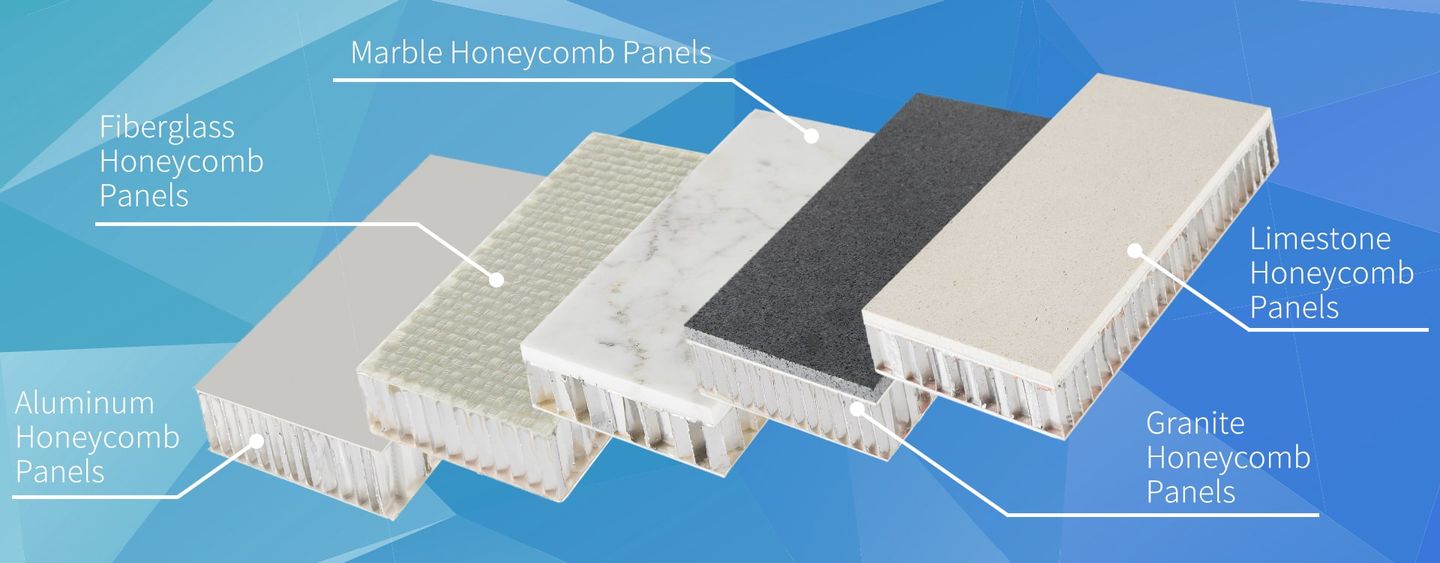
Fiberglass honeycomb panels consists of two layers of fiberglass sheets, or one layer fiberglass and the other aluminum sheets, with aluminum honeycomb core in between. This type of panel is designated for backing of stone veneer panels for exterior cladding. Fiberglass itself has similar thermal conductivity with natural stone, therefore even under rapid temperature changes outdoor, stone and fiberglass move along in similar ranges, with keeps the stone veneer panel as a whole keeping straight with minimum bowing.
Honeycomb Fiberglass
KCP manufactures honeycomb fiberglass panels with renowned adhesive from trustworthy suppliers. It is the ideal choice for those who needs backing panels for lamination of their own stone panels.
The Composition
KCP’s fiberglass honeycomb panel is a sandwich structure consist of two layer of fiberglass sheets; Or alternatively one layer fiberglass sheet and the other aluminum sheets, and aluminum honeycomb core in between. All layers are bonding with modified epoxy adhesive to make the panel as a whole.
Guaranteed Bonding
The elder version of fiberglass honeycomb panels available on the market use resin to apply onto fiberglass sheets to form the fiberglass layer. While the resin itself is always the weakest point of the panel as a whole – It usually fails at around 1.2MPa during flatwise tensile strength tests. This is not an ideal statistic especially for exterior cladding panels.
KCP now offers its new-generation fiberglass panels which uses modified epoxy to apply with fiberglass sheets. It is way stronger than the traditional resin. As a result, the tensile strength that can be achieved by our panels reach to 2.5MPa – which is 2 times stronger than the elder version.
- The aluminum honeycomb coreis not just a filler—it’s an integral part of the panel’s overall strength. The core’s density and cell size are finely calibrated to deliver optimum stiffness, stability, and weight distribution. The unique cell configuration optimizes airflow within the structure, leading to excellent thermal and acoustic insulation properties.
Additionally, the choice of aluminum as the core material ensures superb fire resistance, an essential property for many applications.
- The fiberglass sheets serve as the front and back layers of the panel. These sheets undergo a meticulous manufacturing process, incorporating multiple layers of woven fiberglass mats. The mats are then impregnated with specially formulated epoxy resins, providing a high degree of rigidity and wear resistance.
- We use a modified epoxy adhesive to bond all these components into a cohesive whole. This adhesive not only possesses impressive tensile strength but also features flexibility, allowing the panel to adapt to thermal expansions and contractions without compromising its integrity.
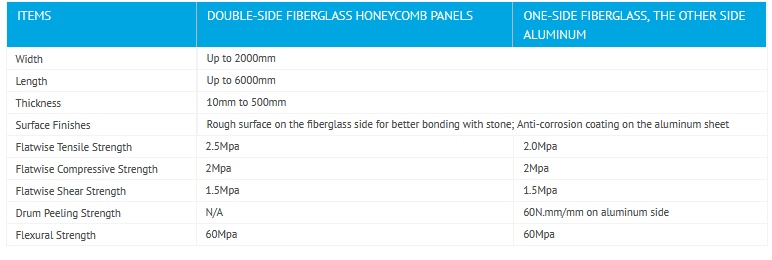
Our fiberglass honeycomb panels come in two configurations for varied needs: panels with fiberglass on both sides and panels with one side fiberglass and the other aluminum.
- The dimensions for both configurations are customizable, with widths up to 2000mm and lengths reaching 6000mm. The thickness can vary between 10mm and 500mm, offering flexibility for different applications.
- Surface finishes vary based on function. The fiberglass side has a rough texture to improve bonding with materials like stone, while the aluminum side features an anti-corrosion coating to enhance its durability.
- In terms of mechanical properties, the panels with fiberglass on both sides have a tensile strength of 2.5Mpa. Those with one fiberglass side and one aluminum side have a slightly reduced tensile strength of 2.0Mpa. The compressive strength for both configurations is 2Mpa, indicating good load-bearing capabilities.
- The shear strength, which measures the panel’s resistance to lateral forces, is 1.5Mpa for both types.
A unique specification for the panels with one aluminum side is the drum peeling strength, which measures 60N.mm/mm. This attribute gauges the panel’s resistance to delamination forces and is not applicable to double-sided fiberglass panels.
Both configurations have a flexural strength of 60Mpa, showing their ability to resist bending and deformation under various loads.
Versatile Applications of Fiberglass Honeycomb PanelsThe potential applications for these fiberglass honeycomb core panels are expansive, capitalizing on the advantages of their lightweight, high-strength, and insulating properties.
- For example, in the field of transportation, these panels are excellent for use in high-speed trains, buses, and commercial vehicles. Their lightweight nature significantly reduces fuel consumption, while their durability ensures longevity, minimizing maintenance costs.
- In the building and construction industry, they serve as ideal sub-floors, ceilings, and partition walls. Their exceptional stiffness and low weight make them easy to install, reducing labor costs and construction times.
- For marine applications, the panels are invaluable. Their resistance to corrosion and moisture makes them perfect for the harsh conditions at sea, whether in commercial ships, yachts, or offshore platforms.
- Finally, they find use in specialized environments like clean rooms and labs. Their smooth, non-porous surfaces are easy to clean and disinfect, while their thermal and acoustic insulation properties help maintain the controlled conditions that these spaces require.
KCP’s fiberglass honeycomb panels are more than the sum of their parts. They are optimized to deliver unparalleled performance in a wide array of applications. With a robust structure, finely calibrated specifications, and a broad range of uses, these panels set a new industry standard for quality and versatility.