


- Home
- Companies
- ANTEC GmbH Analysen- und Prozesstechnik
- Products
- ANTEC - Gel Permeation Chromatography ...
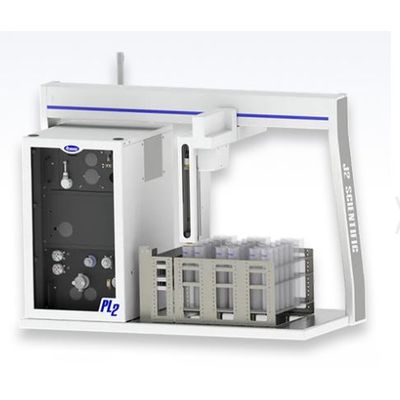
ANTEC - Gel Permeation Chromatography (GPC)
Gel Permeation Chromatography (GPC) is an effective separation technique used, among other things, for sample preparation and extract purification within various analytical processes. The GPC is especially valuable for modular analysis of pesticide residues from food matrices as per ASU L00.0034, showing superiority in terms of extract purification and reducing residues compared to other methods like ASU L00.00113 and ASU L00.00115. It helps achieve higher total extract volumes and often lower determination limits for numerous analytes using identical detection principles. This process significantly reduces the load on downstream chromatographic systems (GC-MS/MS and LC-MS/MS), resulting in minimized maintenance and thus indirect savings in time and costs. The traditional GPC glass column has a gel bed made of porous, crosslinked polystyrene beads, through which the solvent system (often cyclohexane: ethyl acetate) flows at a rate of 5 ml per minute. Low molecular weight substances are slowed down within the gel bed, whereas high molecular weight substances migrate around the beads and reach the top of the column faster, where they are diverted to waste via an automatic valve. The slower-moving substances are directed either to the AccuVap module for simultaneous evaporation or collected in round-bottom flasks. The main advantage of the GPC method lies in the cleanliness of the eluates and the fact that virtually all active ingredients are contained in a fraction of roughly 100 to 250 ml, allowing for the collection through a single sample preparation step. The modular PrepLinc platform offers fully automated sample preparation and extract clean-up, and it is suitable for various sample types including food, water, feed, environmental, fuel, pharmaceutical, and human samples. This platform significantly streamlines and automates laborious and extensive steps of sample cleaning processes.The PrepLinc sample preparation platform can be equipped with a module for gel permeation chromatography.
GPC columns
Low-pressure columns according to §64 LFGB (DFG S19), medium-pressure and high-pressure columns can be connected to and operated on the system.
The column pressure monitor pauses the high-pressure pump if there is excess pressure on the column in order to prevent damage to the GPC column or the system. The excess pressure can be set individually for each column. The column pressure monitor can also be set so that the high-pressure pump is paused even if the pressure falls below a minimum level (leakage).
High pressure pump
The GPC module is equipped with a high pressure pump that generates a back pressure of up to 170 bar at a flow rate of between 1 and 10 ml. This means that in addition to the most commonly used low pressure glass column according to the DFG S19 method with a back pressure of around 0.4 bar, medium pressure columns of up to 170 bar can also be used. A special version of the high pressure pump with a back pressure of up to 375 bar is optionally available.
GPC column change valve (option)
The PrepLinc system can be equipped with a 3-column change valve. This allows up to three different GPC or other preparative columns to be controlled and used within one sample sequence.
In addition, a solvent change valve can be connected to use the PrepLinc system with different mobile phases.
GPC sample loading
The samples are placed in 10 ml sample vials sealed with disposable septa. The sample is introduced using an automatic, high-precision syringe from sealed sample vials into a calibrated sample loop or alternatively via an injection port on the valve.
The PrepLinc program enables partial sample loading, so that in cases where either very little sample material is available or where the expected drug concentration is very low, the entire sample volume is applied to the column without loss.
Smart Tracking
The autosampler's sample needle can be controlled to track just below the sinking surface (Smart Tracking™) to minimize the uptake of sediment and to minimize contamination of the sample needle.
UV detectors
The GPC module has connection options for UV detectors to determine the retention times of the GPC and to check the retention times. Two UV detectors are available for connection: a UV detector with a fixed wavelength (254 nm) and a UV detector with a variable wavelength. The retention times determined from the GPC column reports can be transferred directly to the methods.
Usually, only one fraction containing all active ingredients is collected with GPC. However, the control program also allows division into any number of fractions, only limited by the number of available collection positions (>140 possible).
When using the AccuVap module, the sample is fed inline to the evaporation module and concentrated during the Collect phase. The sample can also be fed inline to the SPE module or to the filtration module during the Collect phase.
Sample tables
There are different sample tables to choose from.
If the PrepLinc is only operated with GPC, sample tables are usually used into which 250 ml round-bottom flasks with NS 29/32 are suspended. These can then be used directly in the rotary evaporator without any transfer work.