

- Home
- Companies
- Acoustiblok
- Products
- Acoustiblok QuietFiber - Model QF2 – ...
Acoustiblok QuietFiber - Model QF2 – QF4 – QF6 -Hydrophobic Industrial Noise Absorption Material
Performance: QuietFiber material is specifically engineered to tackle the frequencies of sound that are critical for noise reduction. QuietFiber’s Noise Reduction Coefficient (NRC), ranges from 1.0- 1.25 depending on the version (Q2, Q4 or Q6). An NRC rating of 1.0 or higher means there are no reflections off of the material. Any material with an NRC that is greater than 0.50 is considered to be sound absorbing. If the NRC is less than 0.20, the material is considered to be sound reflecting. If the material has an NRC rating of say 0.60, it would have about 40% reflections off of the material. As a result, NRC materials are typically used for reflection control in spaces with high Reflection or Reverb Times (RT’s).
AcoustiFence is a flexible material. This yields coincidental gains in attenuation at those specific frequencies where rigid barriers have strong deficiencies. As a result you will see much higher levels of performance using Acoustifence than you would using typical construction materials. This also means that Acoustifence is a great solution compared to a wooden fence or any other type of reflective barrier.Ease of Use
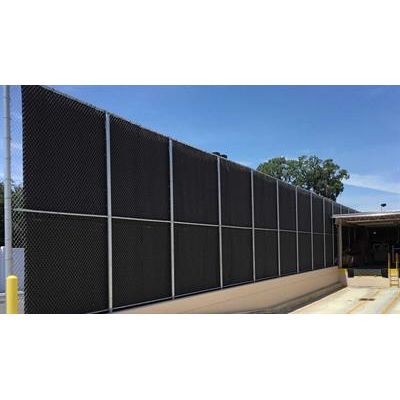
Acoustifence is extremely easy to install. You can secure it to a chain link fence, sandwich it between a wooden shadow box fence, or secure it to a frame as a stand alone material. This allows for a quick installation and a quick resolution to any noise complaints.
Acoustifence comes equipped with standard edge reinforcement and mounting grommets. We offer installation suggestions for each type of installation.Details
Acoustifence is 1/8” thick and comes in standard sizes of 6’ x 30’. You can also order custom lengths and if your project involves greater heights, AcoustiFence can be installed vertically rather than horizontally.
AcoustiFence has an acoustical performance of STC 28, which gives you a transmission loss of 28dB through the material. It is worth noting that the level of attenuation of all outdoor barriers is affected by a variety of factors including end diffraction, angle of diffraction, wind direction, humidity and temperature.