


- Home
- Companies
- ITK Envifront AB
- Products
- ITK Envifront - Active Particle ...
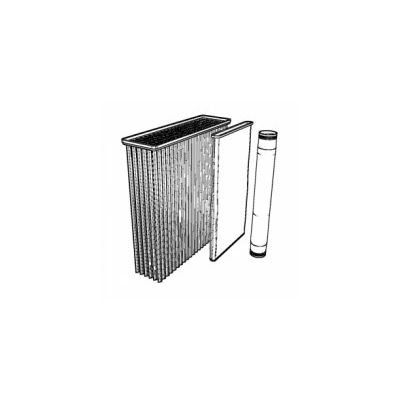
ITK Envifront - Active Particle Filtration Surfaces
This standard is a measure of the properties of the filtration surface. Melted fibres at gasflaming or calendering at too high temperature will diminish the active (open) filtration surface. This will of course mean increased filtration velocity through dust cake as well as filtercloth.
The norm developed by ITK Envifront gives a precise measure of the capacity class of the filter cloth. The method implies that the resistance over the filter cloth with a dust deposit of standardized classified test dust is measured. The achieved resistance is then compared with resistance from a virgin sample filter cloth. By the method a measure on the effective active filtration surface, which means that destroyed areas, such as melted "plasticized" areas on fibrous felts or glue spots on membrane filter cloths, are detected in an objective way. Filtration class; Virgin efficiency (EFN 9412 B) The experience has shown that the less the penetration of particles through the filter cloth is, the better will the stability in collection efficiency as well as flow capacity be. EFN 9412B is carried out in conjunction with EFN 9412A by measuring the penetration of particles through the dust cake and filter cloth. In this way an objective measure of the collecting efficiency is achieved. We call it virgin efficiency.
A filter cloth is moslty installed in filter designs equipped with jetpulse or pulse cleaning by means of compressed air jets. In such designs the jet pulse is allowed to expand inside a filter bag. This expansion of compressed air creates a shaking of the filter cloth. By accelerating the filter cloth and dust cake out from the bag cage followed by retardation when it reaches it`s circular shape like a cylinder. It is important that this acceleration- and retardation movement is made as effective as possible to minimise the internal losses such as contraction.
ITK Envifront has since 1989 created procedures to maximize the yield of the pulse cleaning pressure and presented methods to upgrade pulse cleaning systems on existing installations. The typical pressure pulse, induced inside a filter bag by today`s standards, are between 1.0 kPa up to in best cases 10 kPa. This means that the pressure inside the air tank often is 600 kPa since the expansion is reduced on it`s way to the filter bag to around, or slightly above one hundreds. Furthermore, in the forces to accelerate the filter cloth a great part of the 1.0-10.0 kPa forces will be lost just in bending the filter cloth.