


- Home
- Companies
- S.P. Kinney Engineers, Inc.
- Products
- Kinney - Model A - Automatic ...
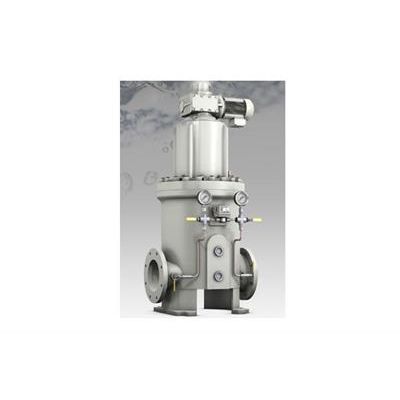
Kinney - Model A -Automatic Self-Cleaning Strainer
Kinney is most noted for our heavy-duty Model A and Model AP Automatic Self-Cleaning Strainers . Both models are designed for continuous removal of suspended particles from all types of liquids. The Model A is designed for operation under positive pressure (20 psi or greater). Pipeline sizes range from 2` - 60` and larger. Both models employ the use of a rotating cylindrical drum with a number of threaded holes containing one of many types of straining media. The drum is supported on a rotating shaft fitted with bearings and is contained in a body having a vertical backwash slot opening adjacent to the drum surface.
Designed for continuous removal of suspended particles from all types of liquids. Applications are in Industrial Plants, Power Plants, WWTP, and Paper Mills using river, lake, well, or sea water for cooling, descaling, bearing, lubrication, spraying, quenching, and similar purposes. Pipeline size: 2" - 60" & larger. Liquids other than water, such as chemicals, acids, white water (paper mills), sewage, and ammonia flushing liquor (coke plants) can also be effectively strained.
Installation is made on the discharge side of a pump or in any piping system operating under a positive pressure. The minimum working pressure required to effectively clean the straining media is 20 psi. The strainer is compact with small face-to-face, width, and height dimensions.
The strainer consists of a cylindrical drum with a number of threaded holes containing one of many types of straining media. The drum is supported on a rotating shaft fitted with bearings and is contained in a body having a vertical backwash slot opening adjacent to the drum surface.
The liquid to be strained enters the inlet connection located in the lower portion of the body and flows around the outer surface of the drum. The suspended particles are retained in the media pockets and the clean liquid passes through the media to the inside and bottom opening of the drum-leaving the body at the outlet connection located diametrically opposite the inlet.
As each row of straining media passes the backwash slot, a reversal of flow occurs, flushing the suspended particles from the media pockets. This reversal of flow is caused by a pressure differential between the interior of the strainer and atmosphere. The backwash flow rate is exceptionally low and will vary, depending on the amount of suspended particles in the liquid. The backwash piping should discharge into an open funnel immediately after the backwash valve.
In lieu of a manually operated valve on the backwash outlet line, an automatic control can be furnished to permit intermittent backflushing. This control consists of a motor or pneumatic cylinder operated ball valve, actuated by a timer or a pressure differential switch (or both).
The clearance between the backwash slot and the drum is equal to or smaller than the opening presented in the media and can be adjusted easily by two locknuts on the threaded part of the top section of the shaft. The backwash slot contains a knife-like edge which enables the strainer to shear debris such as wood, shells, fish, and other suspended materials which may extend beyond the surface of the drum-with no resultant damage tot he drum, straining media, or drive unit.
The straining media can be easily inspected or changed through an removable cover in the side of the strainer body, or the entire drum assembly can be lifted from the body for inspection or changing of media.