


- Home
- Companies
- Lectrodryer, LLC
- Products
- Lectrodryer - Dewpoint Apparatus
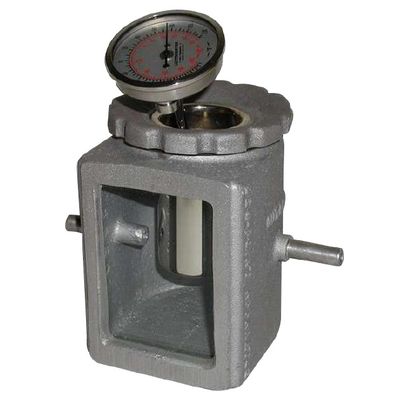
Lectrodryer - Dewpoint Apparatus
A simple inexpensive means for determining the moisture content of air and other non-corrosive gases at atmospheric pressure.
A simple inexpensive means for determining the moisture content of air and other non-corrosive gases at atmospheric pressure.
Durability
The outer container is a polished dense aluminum casting which will withstand rough handling. It is chemically inert to most gases, minimizing any corrosion problems. The observation window is a two ply safety glass which resists shattering. It is sealed in place with a special cement.
Tight Construction
The overall tight construction eliminates possible error in readings due to infiltration of atmospheric moisture. The inlet and outlet connections are integral parts of the cast outer container. The polished cup is positioned with a guide ring which insures that the cam locks on the cap will be properly engaged and the cup assembly will be locked on an “O” ring.
Ease & Accuracyof Use
The size and shape of the complete apparatus adds to the ease in handling. Less than a quarter turn locks the polished cup in place. The cap is funneled to minimize the boiling over of acetone. The cup is nickel plated for a long lasting, non-blemished, easily cleaned mirror surface for accurate observation.
Range
A dual scale dial thermometer graduated from minus 100 °C to plus 50 °C can be provided to cover the normal range of dewpoint readings.
- The air or gas sample is introduced through the inlet by passing it through metal tubing. The tubing should be butted against the inlet port and held firm by slipping a rubber tubing over the connection. Caution – Do not use at pressures above 2 PSIG.
- Pass a sample flow gas through the dewpoint apparatus. Adjust the flow to about 5 CFH. This flow can be felt when blown against wetted lips but is not readily felt by the hand.
- Pour acetone (about 2”) into the cup. Caution – acetone is flammable.
- After the sample has passed through the apparatus for about five minutes in order to purge it completely, small amounts of crushed dry ice should be added to the acetone while stirring constantly with the thermometer.
- At the first sign of dew or moisture on the polished surface the temperature is read from the thermometer. This reading is an accurate indication (within plus or minus 3 ° C) of the dewpoint of the gas or air to be tested. The use of a mixture of acetone and dry ice in the dewpoint apparatus makes possible the checking of dewpoints as low as -76 °C. By careful practice and a little skill, Dewpoints can be checked quite closely by several different operators and the results tie in satisfactorily with more expensive gravimetric methods for the determination of the moisture content.
- From the data chart included, the dewpoint temperature may be converted to absolute moisture content.
A reasonably bright light, preferably equipped with a shade, should be used to illuminate the polished cup so that the very first faint trace of dew can be detected. The light should be held in such a position that there will be the least glare from the polished surface.
It is suggested that the temperature of the acetone dry ice mixture should be lowered slowly in order to minimize any error due to temperature lag.
In measuring dewpoints, the surface of the polished cup should be clean and free from any grease, etc. If the surface is not clean, the appearance of the dew may not be a sharp as desired and may cause errors. The proper technique is usually gained only after some practice in making these dewpoint determinations.
When polishing the cup it is suggested that a soft optical tissue be used to prevent scratching the surface.